
Welcome to the Crustaceans subsite on Invertebrate Paleontology!
Please enter a genera name to retrieve more information.
Schizocythere
Classification
Phylum:
Arthropoda
Subphylum:
Crustacea (superclass)
Class:
Ostracoda
Order:
Podocopida
Suborder:
Podocopina
Superfamily:
Cytheracea
Family:
Schizocytheridae
Formal Genus Name and Reference:
Schizocythere TRIEBEL, 1950
Type Species:
S. hollandica
Images
(Click to enlarge in a new window)
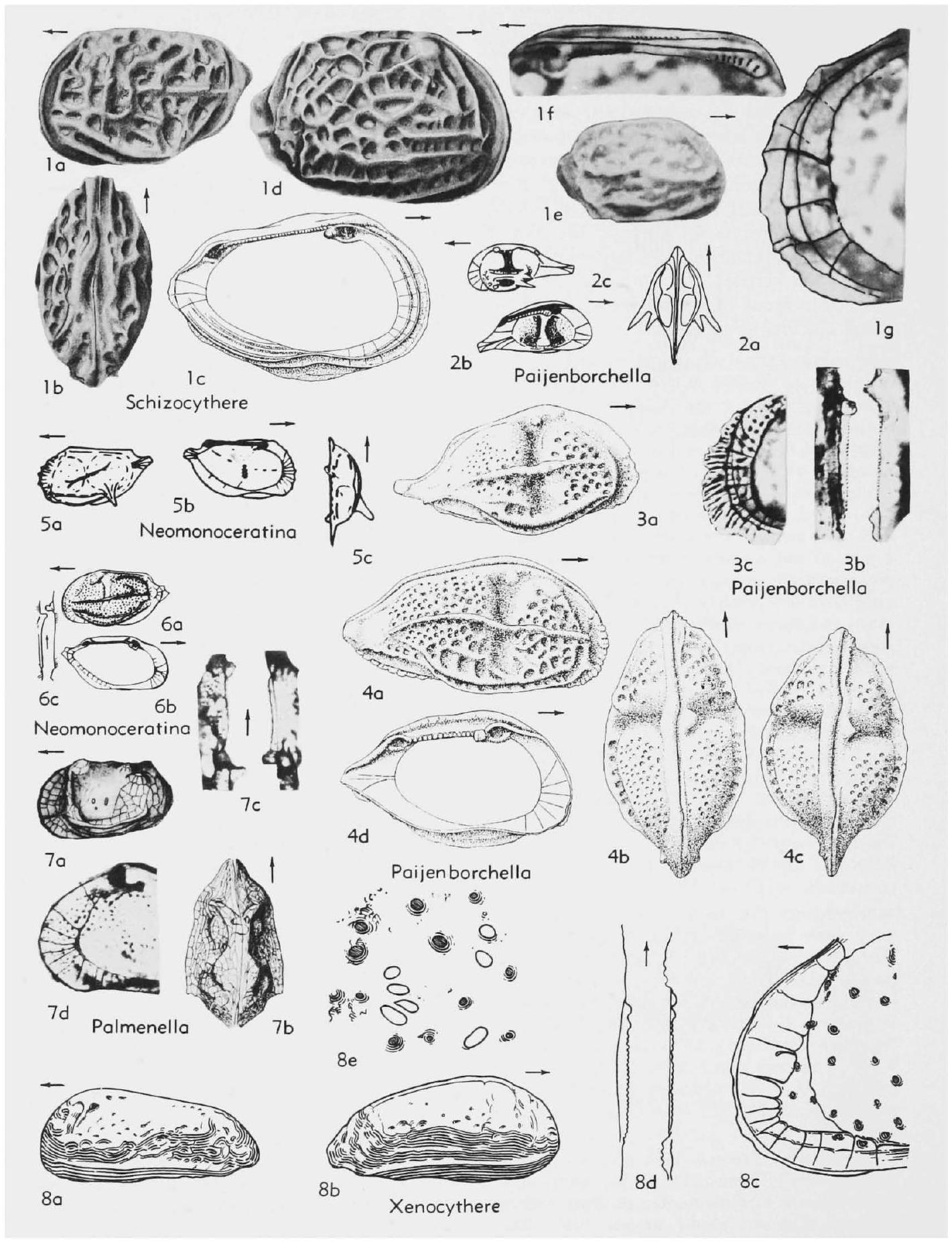
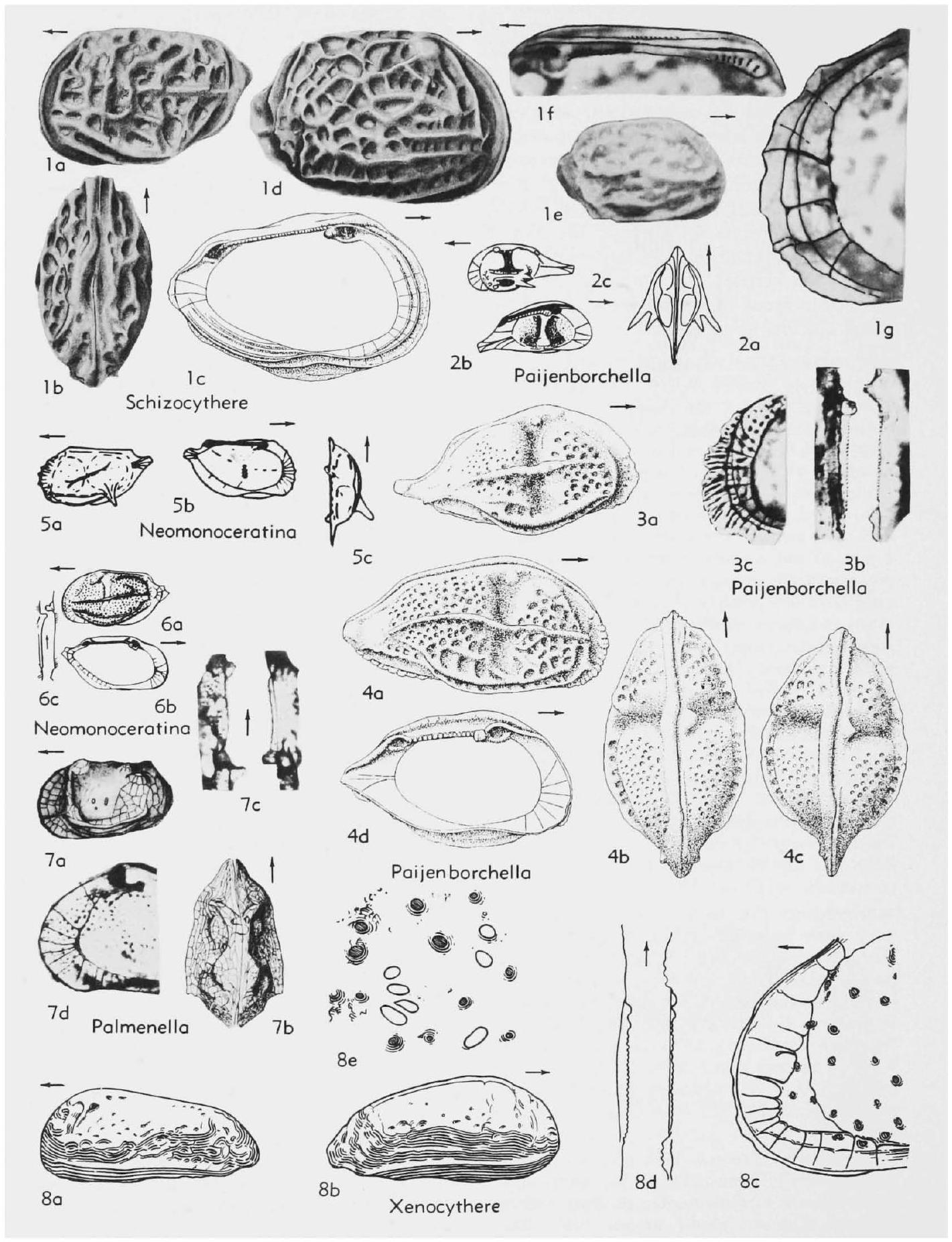 Fig. 256, 1a-c. S. batjesi Keij, Eoc.(Led.-Barton.), Belg., 1a, LV lat. (Barton.), X67, 1 b, carapace dors. (Led.), X77, Ic, LV int. (Barton.), X75 (42). -- Fig. 256,1d. S. tessellata (Bosquet), Eoc. (Lutet.), Fr.(Paris Basin), RV lat., X65 (42). -- Fig. 256,1e-g. *S. hollandica, Mio., Holl., 1e, RV lat., X45, 1f, RV hinge, X100, 1g, RV radial pore canals, X137 (all 376 )
Synonyms
Geographic Distribution
Eu.
Age Range
Beginning Stage in Treatise Usage:
Eoc.
Beginning International Stage:
Ypresian
Fraction Up In Beginning Stage:
0
Beginning Date:
56
Ending Stage in Treatise Usage:
Mio.
Ending International Stage:
Messinian
Fraction Up In Ending Stage:
100
Ending Date:
5.34
Description
Carapace small to medium in size, ovate in side view, posterior extremity being slightly angulated near middle, above which it is weakly concave in RV, ovate in dorsal view; surface pitted to strongly reticulate, with distinct eye tubercle and in most species a tendency to have rib separating lateral and ventral surfaces. Hinge schizodont, in RV with split anterior tooth, deep socket divided in 2 parts at end, crenulate hinge furrow and lobed posterior tooth; anterior tooth bifid in IV, marginal areas very broad, with about 5 straight radial canals on anterior part, normal canals rather large, widely spaced, sieve-like; muscle scars in somewhat curved row of 4 adductors, in front of which are single rounded antennal and mandibular scars very difficult to see.
References
Museum or Author Information
Classification
Phylum:
Arthropoda
Subphylum:
Crustacea (superclass)
Class:
Ostracoda
Order:
Podocopida
Suborder:
Podocopina
Superfamily:
Cytheracea
Family:
Schizocytheridae
Formal Genus Name and Reference:
Schizocythere TRIEBEL, 1950
Type Species:
S. hollandica
Images
(Click to enlarge in a new window)
Fig. 256, 1a-c. S. batjesi Keij, Eoc.(Led.-Barton.), Belg., 1a, LV lat. (Barton.), X67, 1 b, carapace dors. (Led.), X77, Ic, LV int. (Barton.), X75 (42). -- Fig. 256,1d. S. tessellata (Bosquet), Eoc. (Lutet.), Fr.(Paris Basin), RV lat., X65 (42). -- Fig. 256,1e-g. *S. hollandica, Mio., Holl., 1e, RV lat., X45, 1f, RV hinge, X100, 1g, RV radial pore canals, X137 (all 376 )
Synonyms
Geographic Distribution
Eu.
Age Range
Beginning Stage in Treatise Usage:
Eoc.
Beginning International Stage:
Ypresian
Fraction Up In Beginning Stage:
0
Beginning Date:
56
Ending Stage in Treatise Usage:
Mio.
Ending International Stage:
Messinian
Fraction Up In Ending Stage:
100
Ending Date:
5.34
Description
Carapace small to medium in size, ovate in side view, posterior extremity being slightly angulated near middle, above which it is weakly concave in RV, ovate in dorsal view; surface pitted to strongly reticulate, with distinct eye tubercle and in most species a tendency to have rib separating lateral and ventral surfaces. Hinge schizodont, in RV with split anterior tooth, deep socket divided in 2 parts at end, crenulate hinge furrow and lobed posterior tooth; anterior tooth bifid in IV, marginal areas very broad, with about 5 straight radial canals on anterior part, normal canals rather large, widely spaced, sieve-like; muscle scars in somewhat curved row of 4 adductors, in front of which are single rounded antennal and mandibular scars very difficult to see.