
Welcome to the Crustaceans subsite on Invertebrate Paleontology!
Please enter a genera name to retrieve more information.
Paracypris
Classification
Phylum:
Arthropoda
Subphylum:
Crustacea (superclass)
Class:
Ostracoda
Order:
Podocopida
Suborder:
Podocopina
Superfamily:
Cypridacea
Family:
Paracyprididae
Formal Genus Name and Reference:
Paracypris SARS, 1866
Type Species:
P. polita
Images
(Click to enlarge in a new window)
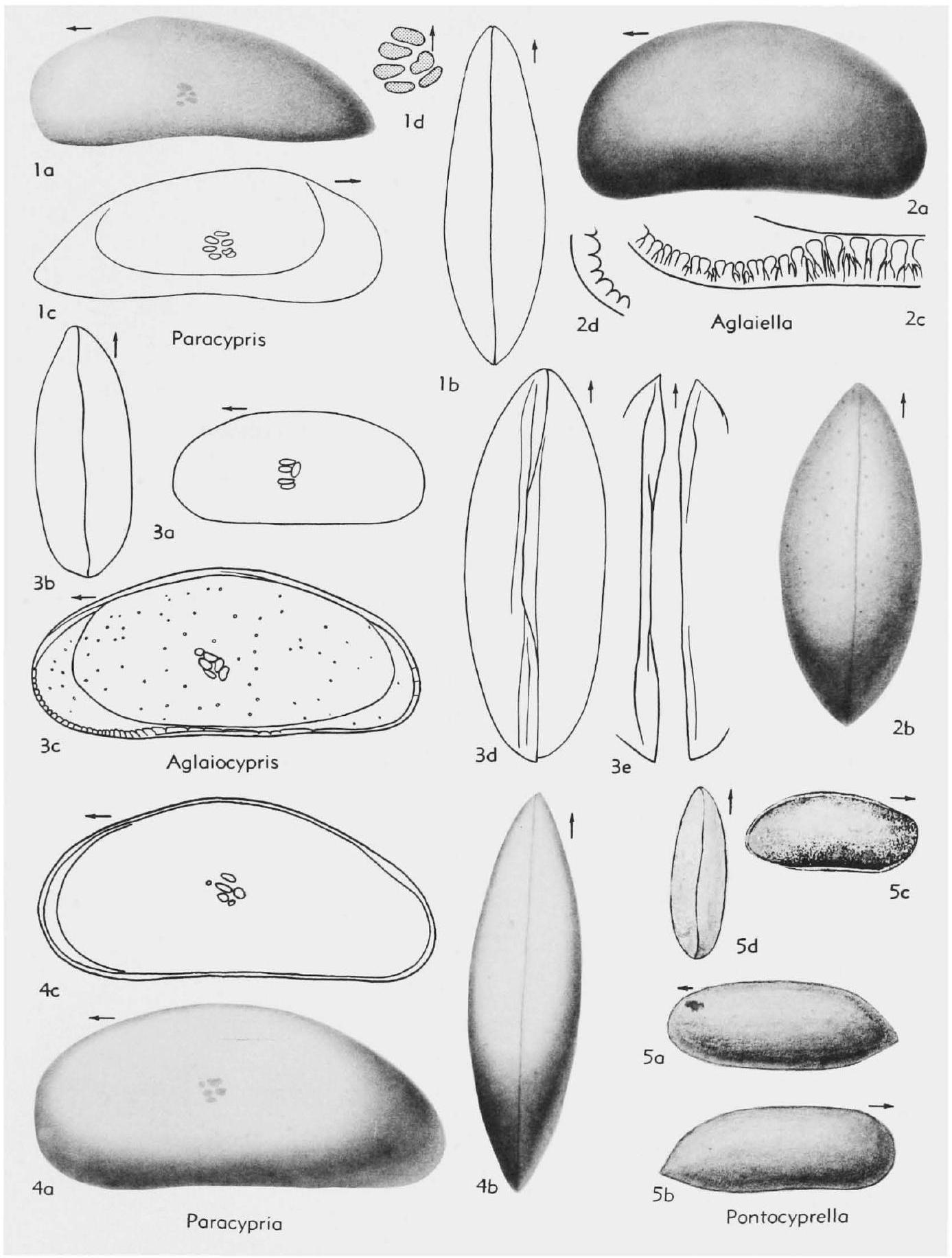 Fig. 181,1. *P. polita, Rec., Norway, 1a,b, male carapace L, dors., X40, 1c, female LV int., X40, 1d, muscle scar, X120 (314).
Synonyms
Geographic Distribution
cosmop.
Age Range
Beginning Stage in Treatise Usage:
Sil., Jur.
Beginning International Stage:
Rhuddanian
Fraction Up In Beginning Stage:
0
Beginning Date:
443.07
Ending Stage in Treatise Usage:
Rec.
Ending International Stage:
Meghalayan
Fraction Up In Ending Stage:
100
Ending Date:
0
Description
Elongated, wedge-shaped, tapering to pointed-posterior; LV larger than RV, very broad inner lamellae, bifurcating radial pore canals. Shape resembles that of Macrocypris but carapace is smaller, dorsum less convex, and muscle-scar spots fewer. [Marine.]
References
Museum or Author Information
Classification
Phylum:
Arthropoda
Subphylum:
Crustacea (superclass)
Class:
Ostracoda
Order:
Podocopida
Suborder:
Podocopina
Superfamily:
Cypridacea
Family:
Paracyprididae
Formal Genus Name and Reference:
Paracypris SARS, 1866
Type Species:
P. polita
Images
(Click to enlarge in a new window)
Fig. 181,1. *P. polita, Rec., Norway, 1a,b, male carapace L, dors., X40, 1c, female LV int., X40, 1d, muscle scar, X120 (314).
Synonyms
Geographic Distribution
cosmop.
Age Range
Beginning Stage in Treatise Usage:
Sil., Jur.
Beginning International Stage:
Rhuddanian
Fraction Up In Beginning Stage:
0
Beginning Date:
443.07
Ending Stage in Treatise Usage:
Rec.
Ending International Stage:
Meghalayan
Fraction Up In Ending Stage:
100
Ending Date:
0
Description
Elongated, wedge-shaped, tapering to pointed-posterior; LV larger than RV, very broad inner lamellae, bifurcating radial pore canals. Shape resembles that of Macrocypris but carapace is smaller, dorsum less convex, and muscle-scar spots fewer. [Marine.]