
Welcome to the Crustaceans subsite on Invertebrate Paleontology!
Please enter a genera name to retrieve more information.
Paijenborchellina
Classification
Phylum:
Arthropoda
Subphylum:
Crustacea (superclass)
Class:
Ostracoda
Order:
Podocopida
Suborder:
Podocopina
Superfamily:
Cytheracea
Family:
Cytheruridae
Formal Genus Name and Reference:
Paijenborchellina KUZNETSOVA, 1957
Type Species:
P. excelens
Images
(Click to enlarge in a new window)
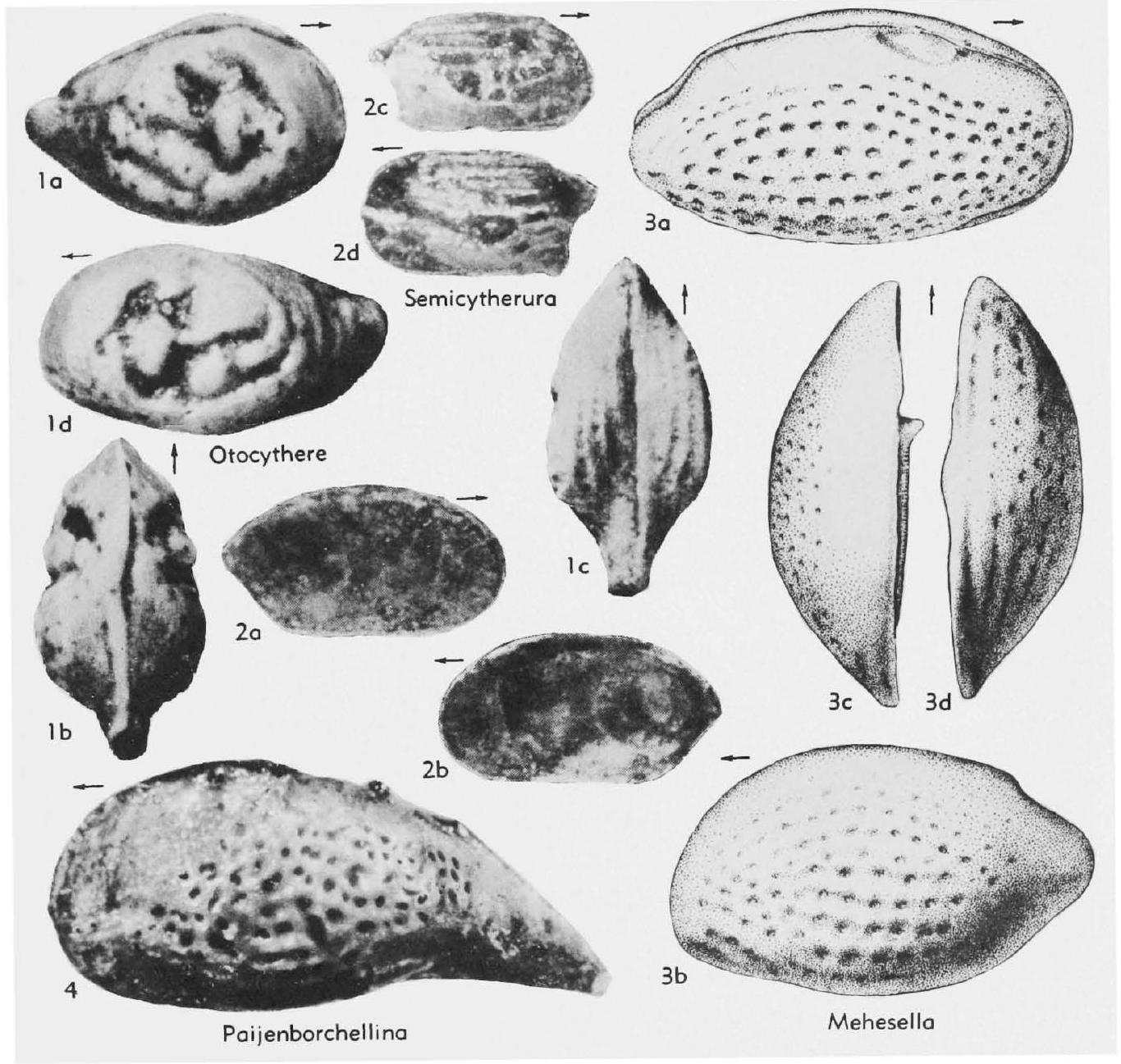
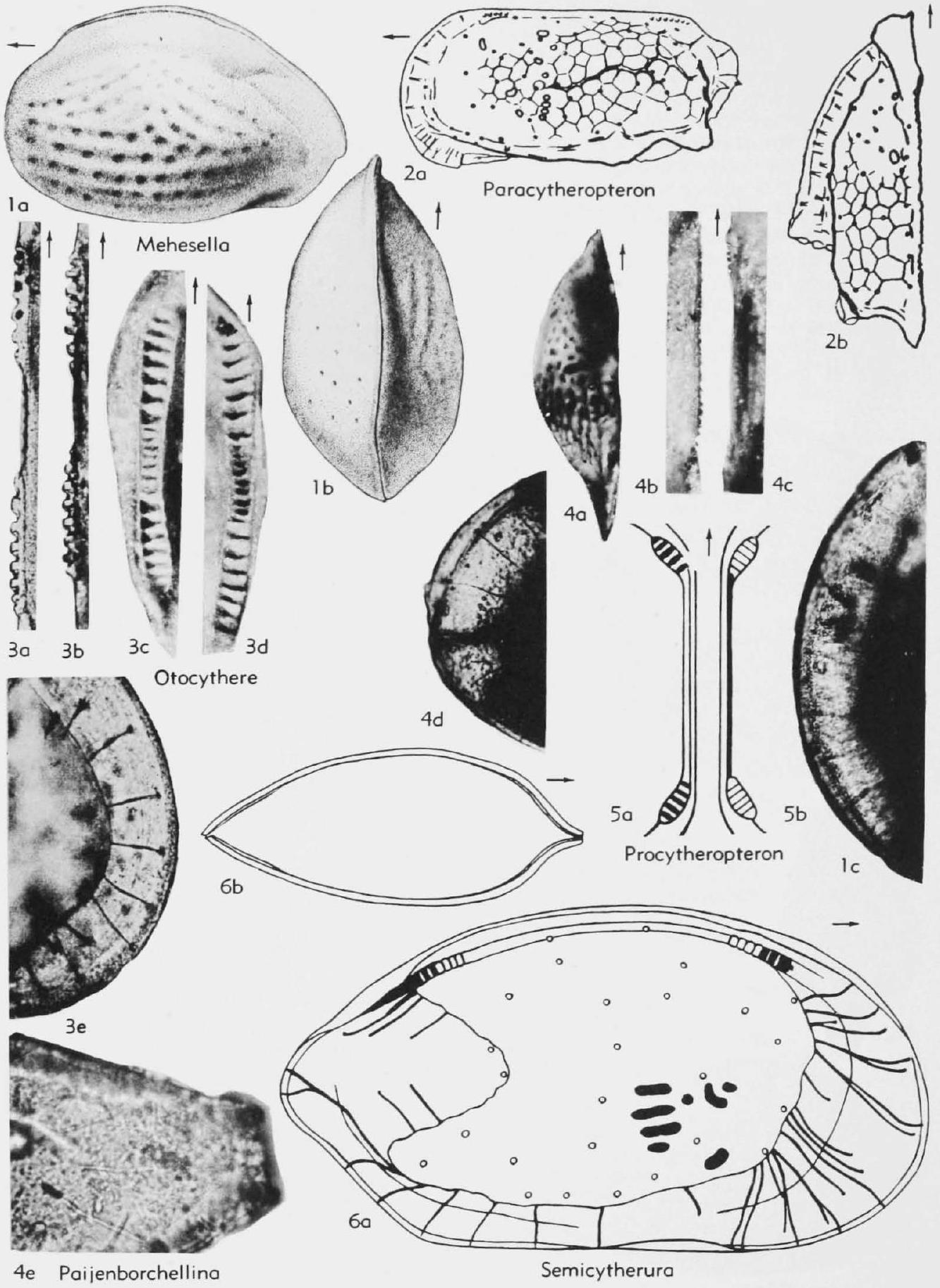
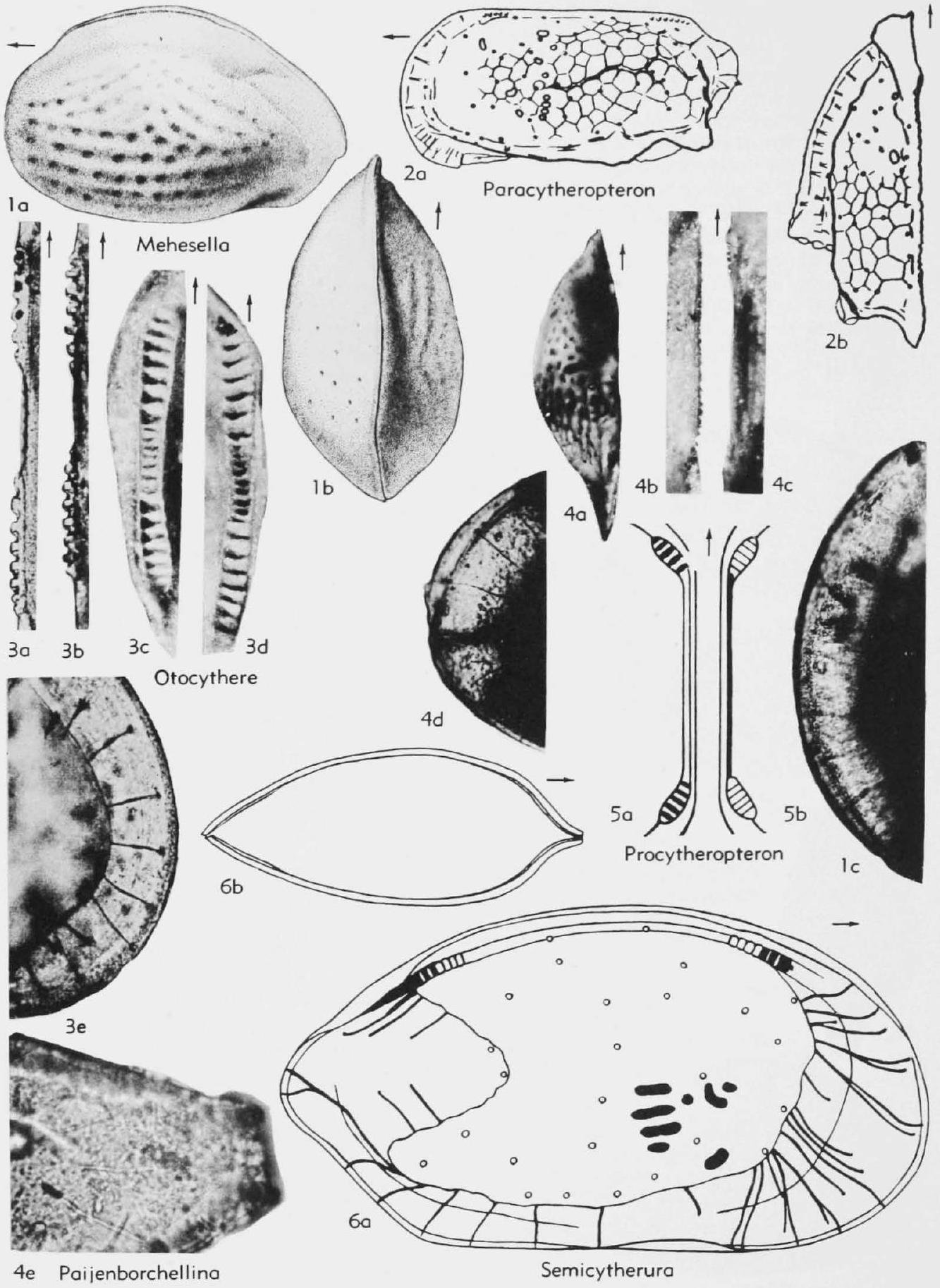
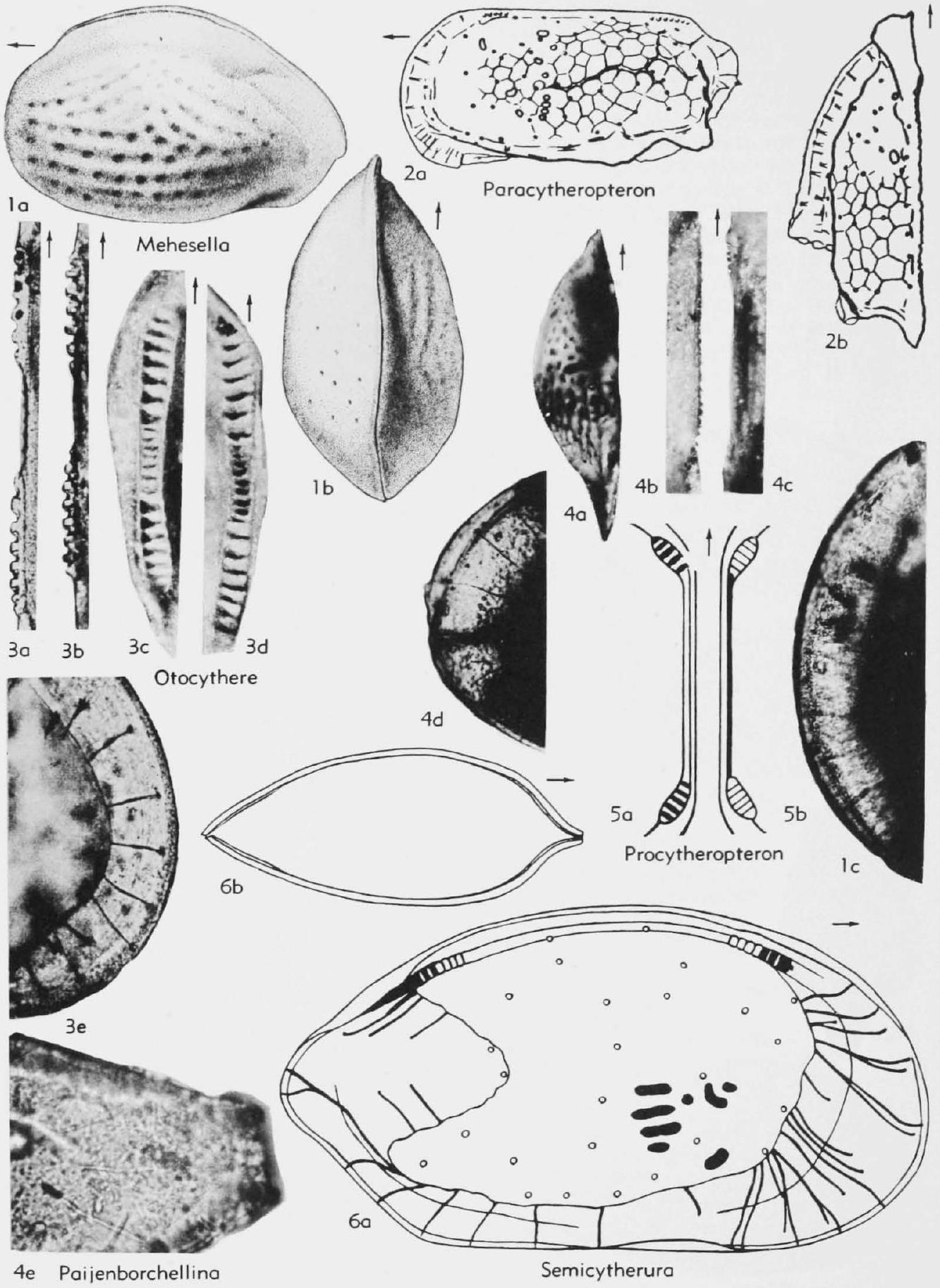 Figs. 223,4, 224, 4. P. ijuensis REVMENT, Eoc., W.Nigeria; 223,4, LV lat., ×125, Fig. 224,4a, LV dors., ×83. 224,4b,c, hinge LV and RV, ×133. 224, 4d,e, RV int., ant. and post., pore canals, ×430 (Reyment, n)
Synonyms
Geographic Distribution
Eu.(USSR)-W.Afr.(Nigeria)
Age Range
Beginning Stage in Treatise Usage:
L.Cret. (Neocom.)
Beginning International Stage:
Berriasian
Fraction Up In Beginning Stage:
0
Beginning Date:
143.1
Ending Stage in Treatise Usage:
Eoc.
Ending International Stage:
Priabonian
Fraction Up In Ending Stage:
100
Ending Date:
33.9
Description
Carapace rather small, pear-shaped, with strongly produced caudal process, valves subequal but LV generally slightly larger than RV; ventral area gently rounded, on each valve bearing sharp rib that runs to base of posterior caudal projection and even onto it; weakly impressed zone from dorsal margin to middle of side; anterior margin fairly broad, provided with narrow outer lip through which canals do not penetrate, inner margin and line of concrescence coincident; anterior marginal pore canals few, straight, with 3 radially arranged canals in caudal process, selvage well developed, located near outer margin; RV hinge with anterior and posterior tooth plates and crenulated median furrow, eye spots feeble, muscle field and dimorphism unknown. Surface with small pits and weak ribs or reticulations.
References
Museum or Author Information
Classification
Phylum:
Arthropoda
Subphylum:
Crustacea (superclass)
Class:
Ostracoda
Order:
Podocopida
Suborder:
Podocopina
Superfamily:
Cytheracea
Family:
Cytheruridae
Formal Genus Name and Reference:
Paijenborchellina KUZNETSOVA, 1957
Type Species:
P. excelens
Images
(Click to enlarge in a new window)
Figs. 223,4, 224, 4. P. ijuensis REVMENT, Eoc., W.Nigeria; 223,4, LV lat., ×125, Fig. 224,4a, LV dors., ×83. 224,4b,c, hinge LV and RV, ×133. 224, 4d,e, RV int., ant. and post., pore canals, ×430 (Reyment, n)
Synonyms
Geographic Distribution
Eu.(USSR)-W.Afr.(Nigeria)
Age Range
Beginning Stage in Treatise Usage:
L.Cret. (Neocom.)
Beginning International Stage:
Berriasian
Fraction Up In Beginning Stage:
0
Beginning Date:
143.1
Ending Stage in Treatise Usage:
Eoc.
Ending International Stage:
Priabonian
Fraction Up In Ending Stage:
100
Ending Date:
33.9
Description
Carapace rather small, pear-shaped, with strongly produced caudal process, valves subequal but LV generally slightly larger than RV; ventral area gently rounded, on each valve bearing sharp rib that runs to base of posterior caudal projection and even onto it; weakly impressed zone from dorsal margin to middle of side; anterior margin fairly broad, provided with narrow outer lip through which canals do not penetrate, inner margin and line of concrescence coincident; anterior marginal pore canals few, straight, with 3 radially arranged canals in caudal process, selvage well developed, located near outer margin; RV hinge with anterior and posterior tooth plates and crenulated median furrow, eye spots feeble, muscle field and dimorphism unknown. Surface with small pits and weak ribs or reticulations.