
Welcome to the Crustaceans subsite on Invertebrate Paleontology!
Please enter a genera name to retrieve more information.
Paijenborchella
Classification
Phylum:
Arthropoda
Subphylum:
Crustacea (superclass)
Class:
Ostracoda
Order:
Podocopida
Suborder:
Podocopina
Superfamily:
Cytheracea
Family:
Schizocytheridae
Formal Genus Name and Reference:
Paijenborchella KINGMA, 1948
Type Species:
P. iocosa
Images
(Click to enlarge in a new window)
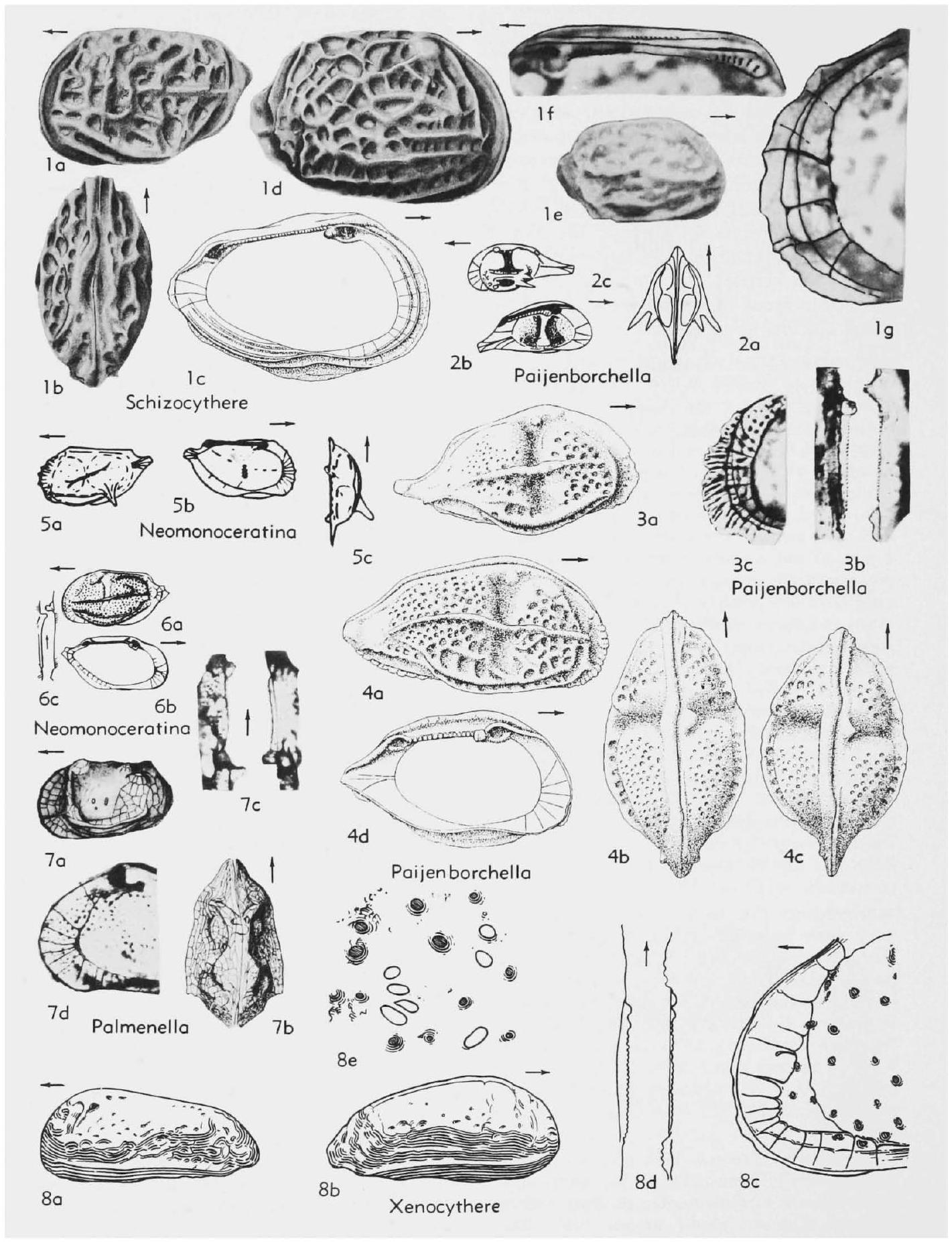 Fig. 256,2. *P. iocosa, Rec., E. Indies(Java), 2a, carapace dors., 2b,c, LV int., RV int., all X30 (46). -- Fig. 256.3. P. eocaenica Triebel, Eoc.(Barton.), Belg., 3a, RV lat., X73 (42), 3b,c, hinge and radial pore canals, enlarged (375). -- Fig. 256,4. P. longicosta Keij, Eoc.(Lutet.), Belg., 4a,b, male carapace R, dors., X78, 4c, female carapace dors., X78, 4d, female LV int., X78 (42)
Synonyms
Payenborchella
Geographic Distribution
U.Cret.-Rec., E.Indies-Eu.-N.Am.
Age Range
Beginning Stage in Treatise Usage:
U.Cret.
Beginning International Stage:
Cenomanian
Fraction Up In Beginning Stage:
0
Beginning Date:
100.5
Ending Stage in Treatise Usage:
Rec.
Ending International Stage:
Meghalayan
Fraction Up In Ending Stage:
100
Ending Date:
0
Description
Carapace with obliquely rounded anterior end and long caudal process near lower posterior margin, nearly vertical sulcus marking middle of valves at position of adductor muscles; valves widest near venter where ridge tends to form ala or develop spine, another horizontal ridge crossing sulcus near middle of valves. Hinge heavy, schizodont, with split anterior teeth, crenulate middle element, and lobed posterior tooth in RV; marginal areas broad, with very few radial canals, adductor scars on median ridge, in front of which appear to be single antennal and mandibular scars
References
Kingma, J. T., 1948, Contributions to the knowledge of the Young-Caenozoic Ostracoda from the Malayan region: $118 \mathrm{p} ., 11 \mathrm{pl}$. (Utrecht).
Museum or Author Information
Classification
Phylum:
Arthropoda
Subphylum:
Crustacea (superclass)
Class:
Ostracoda
Order:
Podocopida
Suborder:
Podocopina
Superfamily:
Cytheracea
Family:
Schizocytheridae
Formal Genus Name and Reference:
Paijenborchella KINGMA, 1948
Type Species:
P. iocosa
Images
(Click to enlarge in a new window)
Fig. 256,2. *P. iocosa, Rec., E. Indies(Java), 2a, carapace dors., 2b,c, LV int., RV int., all X30 (46). -- Fig. 256.3. P. eocaenica Triebel, Eoc.(Barton.), Belg., 3a, RV lat., X73 (42), 3b,c, hinge and radial pore canals, enlarged (375). -- Fig. 256,4. P. longicosta Keij, Eoc.(Lutet.), Belg., 4a,b, male carapace R, dors., X78, 4c, female carapace dors., X78, 4d, female LV int., X78 (42)
Synonyms
Payenborchella
Geographic Distribution
U.Cret.-Rec., E.Indies-Eu.-N.Am.
Age Range
Beginning Stage in Treatise Usage:
U.Cret.
Beginning International Stage:
Cenomanian
Fraction Up In Beginning Stage:
0
Beginning Date:
100.5
Ending Stage in Treatise Usage:
Rec.
Ending International Stage:
Meghalayan
Fraction Up In Ending Stage:
100
Ending Date:
0
Description
Carapace with obliquely rounded anterior end and long caudal process near lower posterior margin, nearly vertical sulcus marking middle of valves at position of adductor muscles; valves widest near venter where ridge tends to form ala or develop spine, another horizontal ridge crossing sulcus near middle of valves. Hinge heavy, schizodont, with split anterior teeth, crenulate middle element, and lobed posterior tooth in RV; marginal areas broad, with very few radial canals, adductor scars on median ridge, in front of which appear to be single antennal and mandibular scars
References
Kingma, J. T., 1948, Contributions to the knowledge of the Young-Caenozoic Ostracoda from the Malayan region: $118 \mathrm{p} ., 11 \mathrm{pl}$. (Utrecht).