
Welcome to the Crustaceans subsite on Invertebrate Paleontology!
Please enter a genera name to retrieve more information.
Macrocypris
Classification
Phylum:
Arthropoda
Subphylum:
Crustacea (superclass)
Class:
Ostracoda
Order:
Podocopida
Suborder:
Podocopina
Superfamily:
Bairdiacea
Family:
Macrocyprididae
Formal Genus Name and Reference:
Macrocypris BRADY, 1867
Type Species:
Cythere minna BAIRD, 1850
Images
(Click to enlarge in a new window)
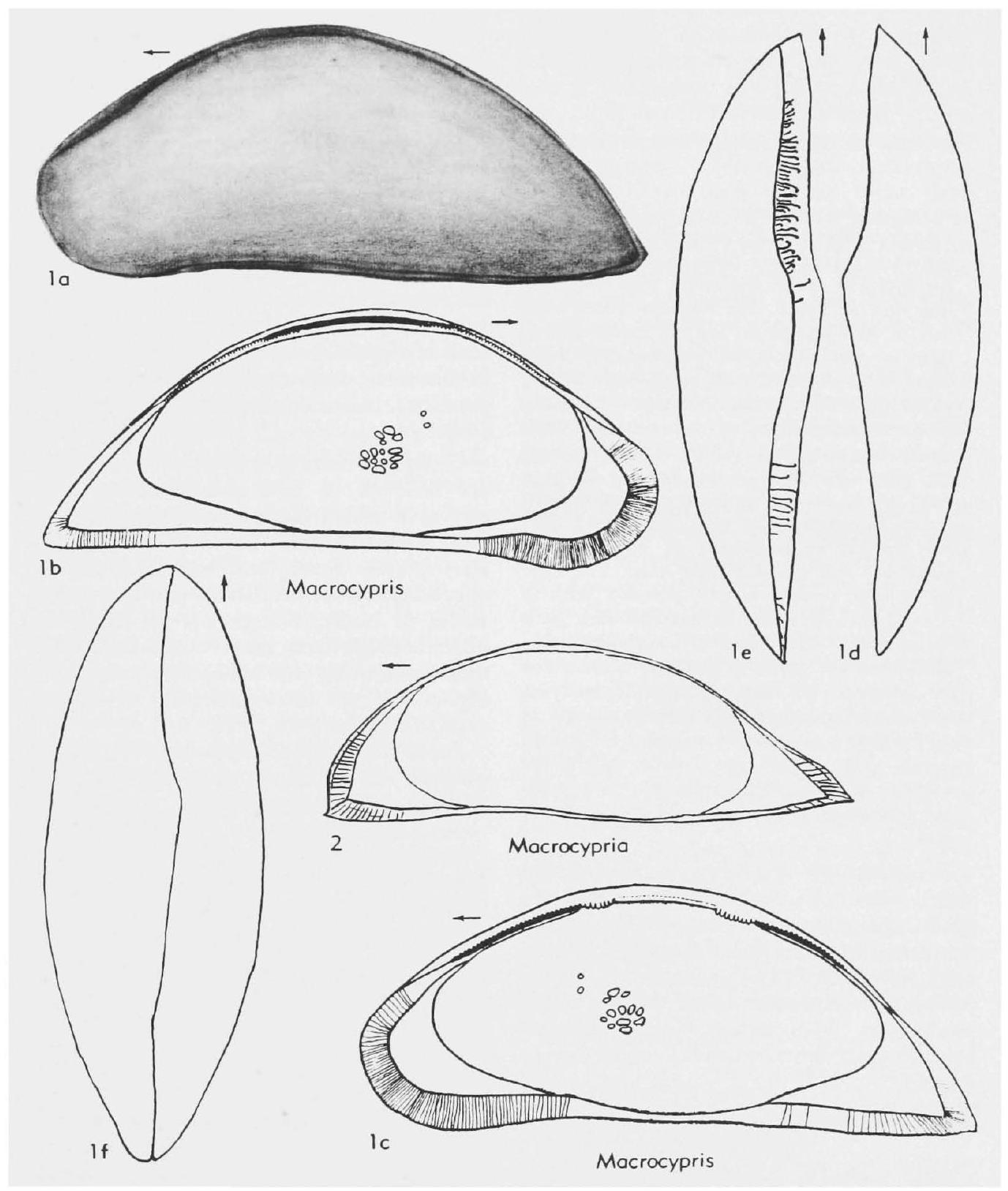 Fig. 146,1; 244,8ab, "*M. minna (BAIRD) Rec., Norway; 146,1a, carapace L, 1b,c, LV int., RV int., 1d,e, LV, RV vent., 1f, carapace vent., all ×30 (Syl-vester-Bradley, 1948); 244,8a,b, LV dors., RV dors., ×125 (Sylvester-Bradley, 1948)
Synonyms
Geographic Distribution
cosmop.
Age Range
Beginning Stage in Treatise Usage:
Ord.-?Mio., Plio.
Beginning International Stage:
Tremadocian
Fraction Up In Beginning Stage:
0
Beginning Date:
486.85
Ending Stage in Treatise Usage:
Rec.
Ending International Stage:
Meghalayan
Fraction Up In Ending Stage:
100
Ending Date:
0
Description
Carapace smooth, compressed, elongate, dorsal margin arched, anterior margin rounded, ventral margin straight or concave, posterior acuminate, RV larger than LV, overreaching it on all margins except anterior. Selvage of both valves projecting prominently in center of ventral margin, that of RV overlapping LV when carapace is closed; duplicature with wide anterior and posterior vestibules; radial pore canals straight, crowded at anterior and posterior ends; normal pore canals small, few, scattered; hinge of 5 elements, in LV terminal elements (both anterior and posterior) being long, denticulate ridges that project, median element a smooth groove, ]ocelJate grooves (shorter than the other elements) between terminal elements and median element, RV with reverse arrangement; muscle-scar pattern consisting of central rosette of about 9 scars, with 3 others close above it and 2 small separated scars in front of and above main group. (Many fossils ranging 'from Ordovician upward have been assigned to this genus, but no pre-Tertiary fossils have been demonstrated to possess the muscle-scar pattern, duplicature an,1 hinge characteristics of type species.]
References
Museum or Author Information
Classification
Phylum:
Arthropoda
Subphylum:
Crustacea (superclass)
Class:
Ostracoda
Order:
Podocopida
Suborder:
Podocopina
Superfamily:
Bairdiacea
Family:
Macrocyprididae
Formal Genus Name and Reference:
Macrocypris BRADY, 1867
Type Species:
Cythere minna BAIRD, 1850
Images
(Click to enlarge in a new window)
Fig. 146,1; 244,8ab, "*M. minna (BAIRD) Rec., Norway; 146,1a, carapace L, 1b,c, LV int., RV int., 1d,e, LV, RV vent., 1f, carapace vent., all ×30 (Syl-vester-Bradley, 1948); 244,8a,b, LV dors., RV dors., ×125 (Sylvester-Bradley, 1948)
Synonyms
Geographic Distribution
cosmop.
Age Range
Beginning Stage in Treatise Usage:
Ord.-?Mio., Plio.
Beginning International Stage:
Tremadocian
Fraction Up In Beginning Stage:
0
Beginning Date:
486.85
Ending Stage in Treatise Usage:
Rec.
Ending International Stage:
Meghalayan
Fraction Up In Ending Stage:
100
Ending Date:
0
Description
Carapace smooth, compressed, elongate, dorsal margin arched, anterior margin rounded, ventral margin straight or concave, posterior acuminate, RV larger than LV, overreaching it on all margins except anterior. Selvage of both valves projecting prominently in center of ventral margin, that of RV overlapping LV when carapace is closed; duplicature with wide anterior and posterior vestibules; radial pore canals straight, crowded at anterior and posterior ends; normal pore canals small, few, scattered; hinge of 5 elements, in LV terminal elements (both anterior and posterior) being long, denticulate ridges that project, median element a smooth groove, ]ocelJate grooves (shorter than the other elements) between terminal elements and median element, RV with reverse arrangement; muscle-scar pattern consisting of central rosette of about 9 scars, with 3 others close above it and 2 small separated scars in front of and above main group. (Many fossils ranging 'from Ordovician upward have been assigned to this genus, but no pre-Tertiary fossils have been demonstrated to possess the muscle-scar pattern, duplicature an,1 hinge characteristics of type species.]