
Welcome to the Crustaceans subsite on Invertebrate Paleontology!
Please enter a genera name to retrieve more information.
Loxoconcha
Classification
Phylum:
Arthropoda
Subphylum:
Crustacea (superclass)
Class:
Ostracoda
Order:
Podocopida
Suborder:
Podocopina
Superfamily:
Cytheracea
Family:
Loxoconchidae
Formal Genus Name and Reference:
Loxoconcha SARS, 1866
Type Species:
Cythere impressa Baird, 1850 (non M'Coy, 1844) ( = C. rhomboidea Fischer, 1855), SD Brady & NORMAN, 1889
Images
(Click to enlarge in a new window)
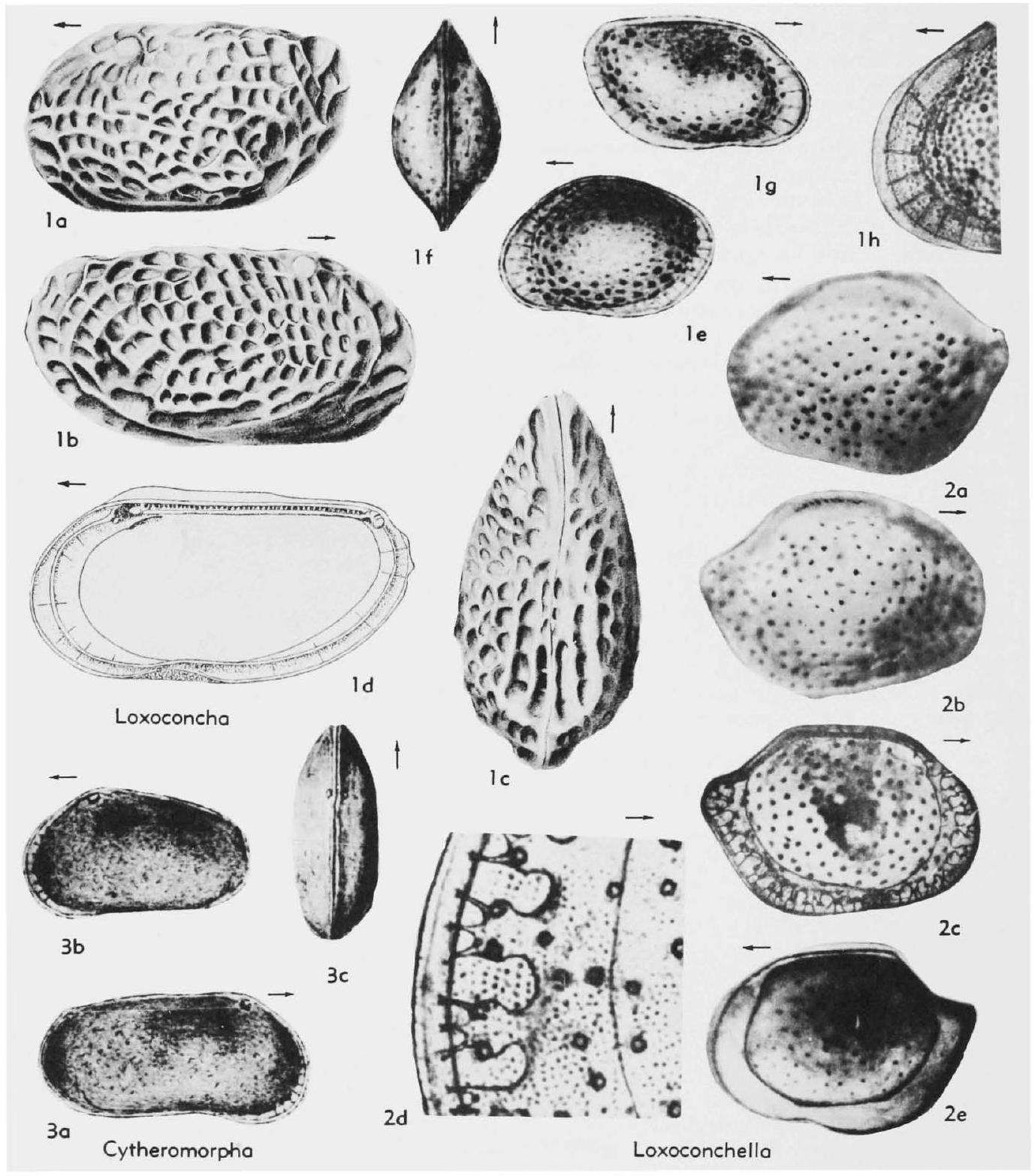
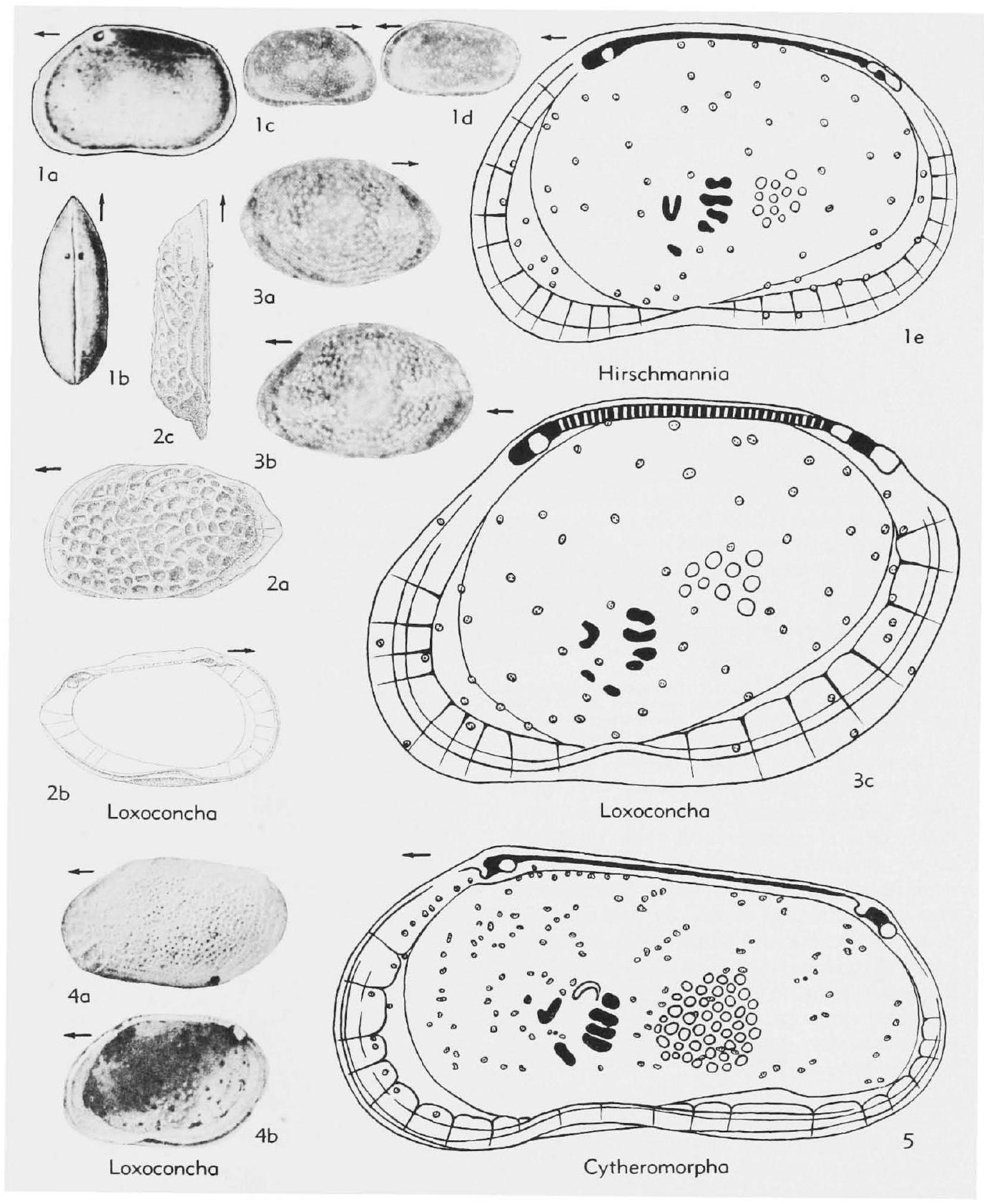
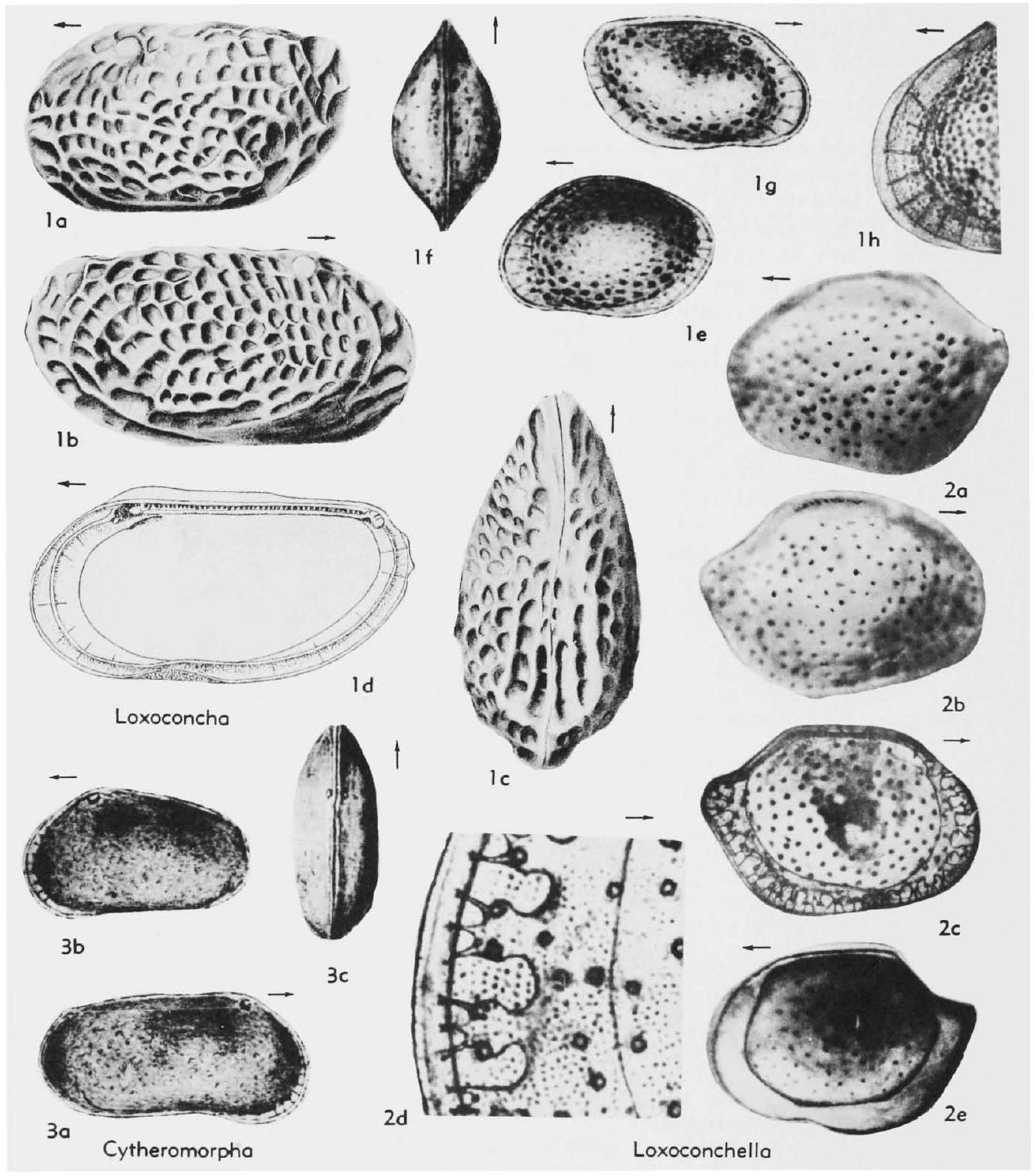
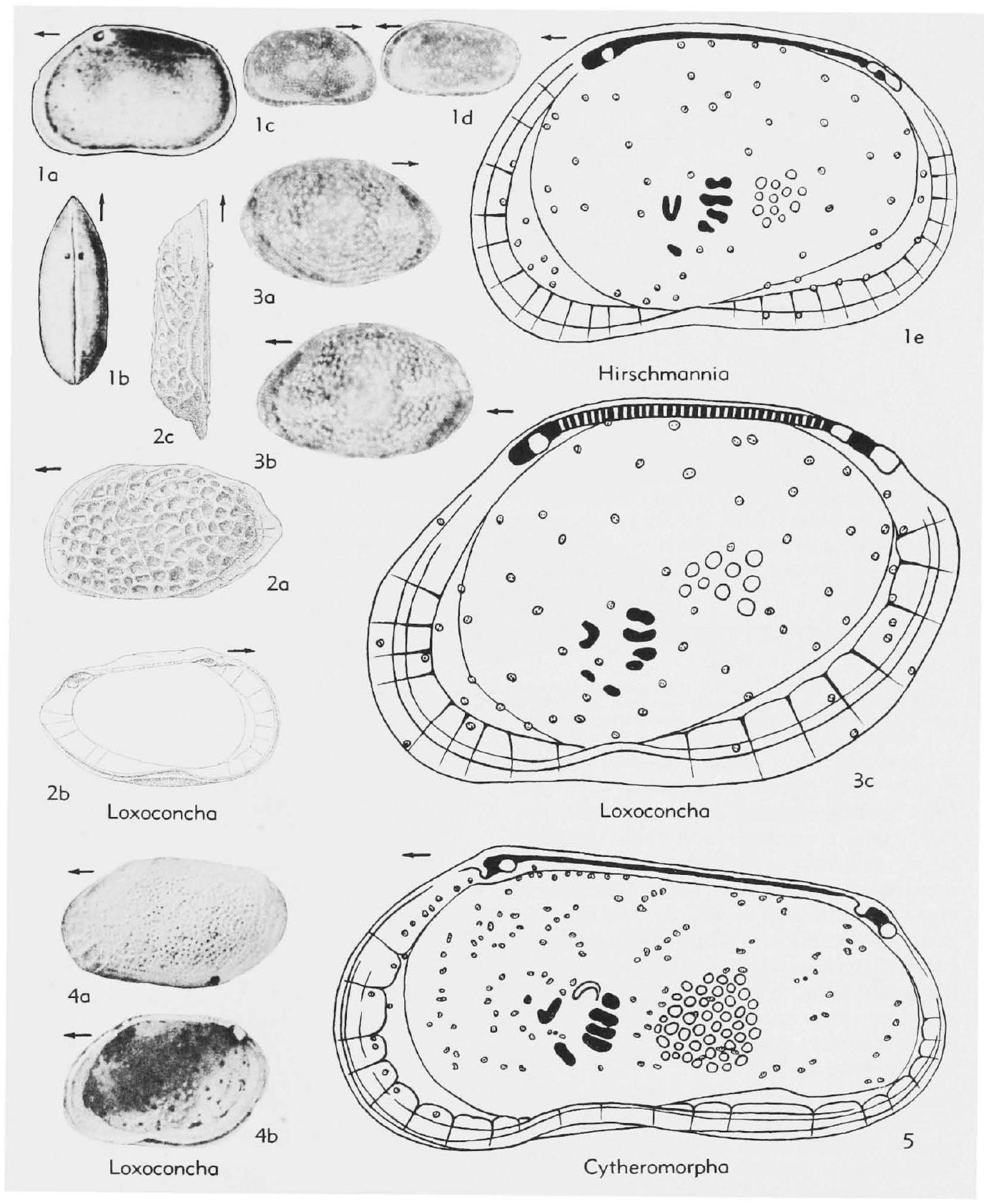 Fig. 240,1e-h, 241,3. *L. rhomboidea (Fischer), Rec., NE.Atl., 240,1e,f, female carapace L, dors., X45, 240,1g, male RV lat., X45, 240,1h, RV int. marginal area with radial canals, X100, 241,3a,b, male RV lat., LV lat., X40, 241,3c, female RV int., X125 (240,1e-g, 220, 240,1h,379, 241,3a-c, 88, by permission of Mouton & Co., The Hague). -- Fig. 241,2. L. curryi Keit, Eoc.(Led.), Eng., 2a-c, male LV lat., int., dors., X80 (42). -- Fig. 240,1a-d. L. grateloupriana (Bosquet), Oligo.-Mio., Eu., 1a-c, female LV lat., male carapace R, dors., X75 (Mio., Fr.), 1d, male RV int., X75 (Oligo., Belg.) (all 42). -= Fig. 241,4. L. matagordensis Swain, Rec., Gulf of Mexico (off Tex.), 4a,b, ?male LV lat., RV int., X50 (355).
Synonyms
Loxoleberis, Normania
Geographic Distribution
cosmop.
Age Range
Beginning Stage in Treatise Usage:
Cret.
Beginning International Stage:
Berriasian
Fraction Up In Beginning Stage:
0
Beginning Date:
143.1
Ending Stage in Treatise Usage:
Rec.
Ending International Stage:
Meghalayan
Fraction Up In Ending Stage:
100
Ending Date:
0
Description
Carapace almond-shaped, with straight dorsal margin and sinuous venter, surface pitted or reticulate. Hinge gongylodont, middle element crenulate. Anterior and posterior vestibules with few straight canals, normal canals widely spaced, adductor scars 4, antennal scar crescent-shaped, mandibular scar oval.
References
Museum or Author Information
Classification
Phylum:
Arthropoda
Subphylum:
Crustacea (superclass)
Class:
Ostracoda
Order:
Podocopida
Suborder:
Podocopina
Superfamily:
Cytheracea
Family:
Loxoconchidae
Formal Genus Name and Reference:
Loxoconcha SARS, 1866
Type Species:
Cythere impressa Baird, 1850 (non M'Coy, 1844) ( = C. rhomboidea Fischer, 1855), SD Brady & NORMAN, 1889
Images
(Click to enlarge in a new window)
Fig. 240,1e-h, 241,3. *L. rhomboidea (Fischer), Rec., NE.Atl., 240,1e,f, female carapace L, dors., X45, 240,1g, male RV lat., X45, 240,1h, RV int. marginal area with radial canals, X100, 241,3a,b, male RV lat., LV lat., X40, 241,3c, female RV int., X125 (240,1e-g, 220, 240,1h,379, 241,3a-c, 88, by permission of Mouton & Co., The Hague). -- Fig. 241,2. L. curryi Keit, Eoc.(Led.), Eng., 2a-c, male LV lat., int., dors., X80 (42). -- Fig. 240,1a-d. L. grateloupriana (Bosquet), Oligo.-Mio., Eu., 1a-c, female LV lat., male carapace R, dors., X75 (Mio., Fr.), 1d, male RV int., X75 (Oligo., Belg.) (all 42). -= Fig. 241,4. L. matagordensis Swain, Rec., Gulf of Mexico (off Tex.), 4a,b, ?male LV lat., RV int., X50 (355).
Synonyms
Loxoleberis, Normania
Geographic Distribution
cosmop.
Age Range
Beginning Stage in Treatise Usage:
Cret.
Beginning International Stage:
Berriasian
Fraction Up In Beginning Stage:
0
Beginning Date:
143.1
Ending Stage in Treatise Usage:
Rec.
Ending International Stage:
Meghalayan
Fraction Up In Ending Stage:
100
Ending Date:
0
Description
Carapace almond-shaped, with straight dorsal margin and sinuous venter, surface pitted or reticulate. Hinge gongylodont, middle element crenulate. Anterior and posterior vestibules with few straight canals, normal canals widely spaced, adductor scars 4, antennal scar crescent-shaped, mandibular scar oval.