
Welcome to the Crustaceans subsite on Invertebrate Paleontology!
Please enter a genera name to retrieve more information.
Healdia
Classification
Phylum:
Arthropoda
Subphylum:
Crustacea (superclass)
Class:
Ostracoda
Order:
Podocopida
Suborder:
Metacopina
Superfamily:
Healdiacea
Family:
Healdiidae
Formal Genus Name and Reference:
Healdia ROUNDY, 1926
Type Species:
H. simplex
Images
(Click to enlarge in a new window)
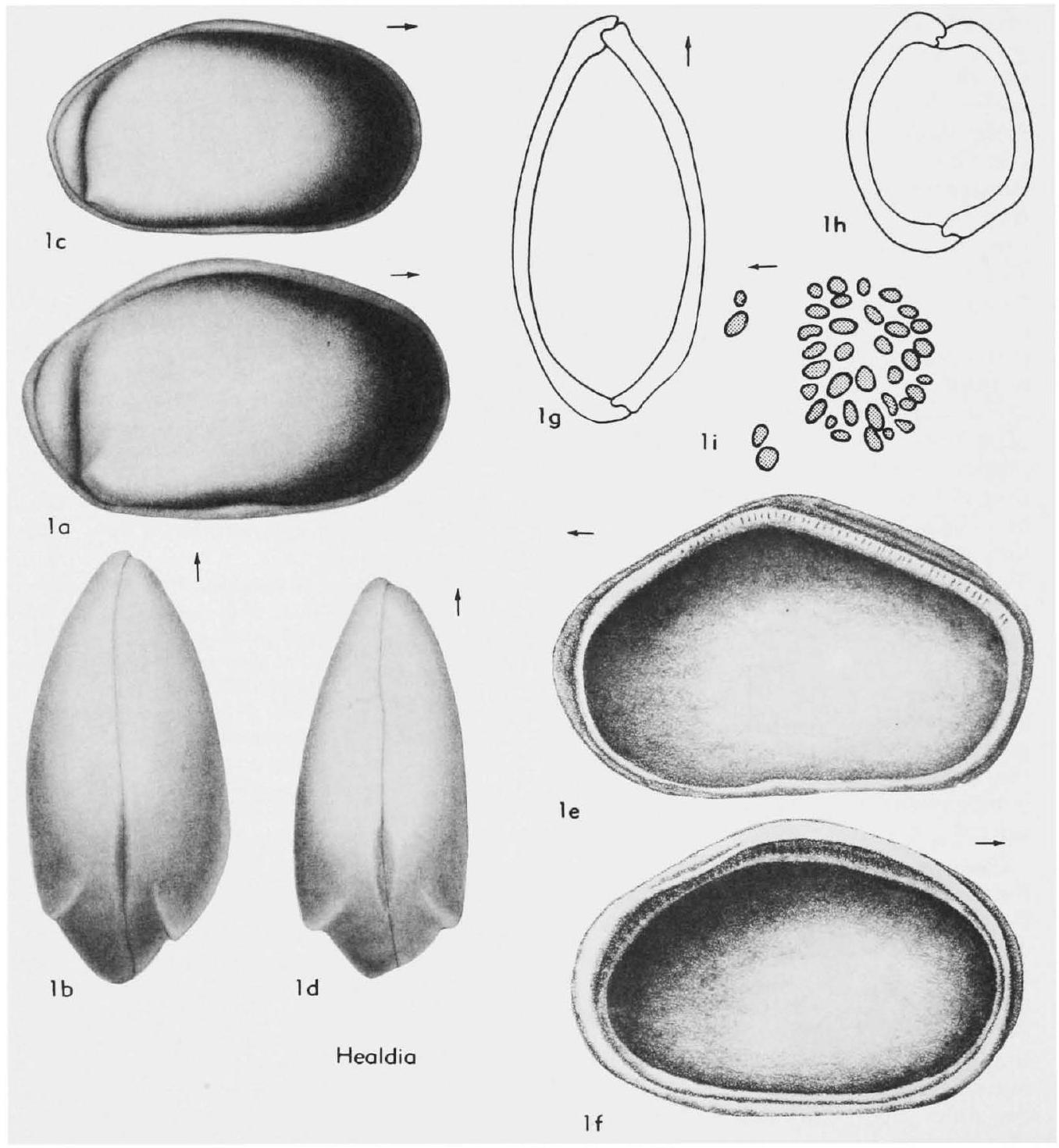
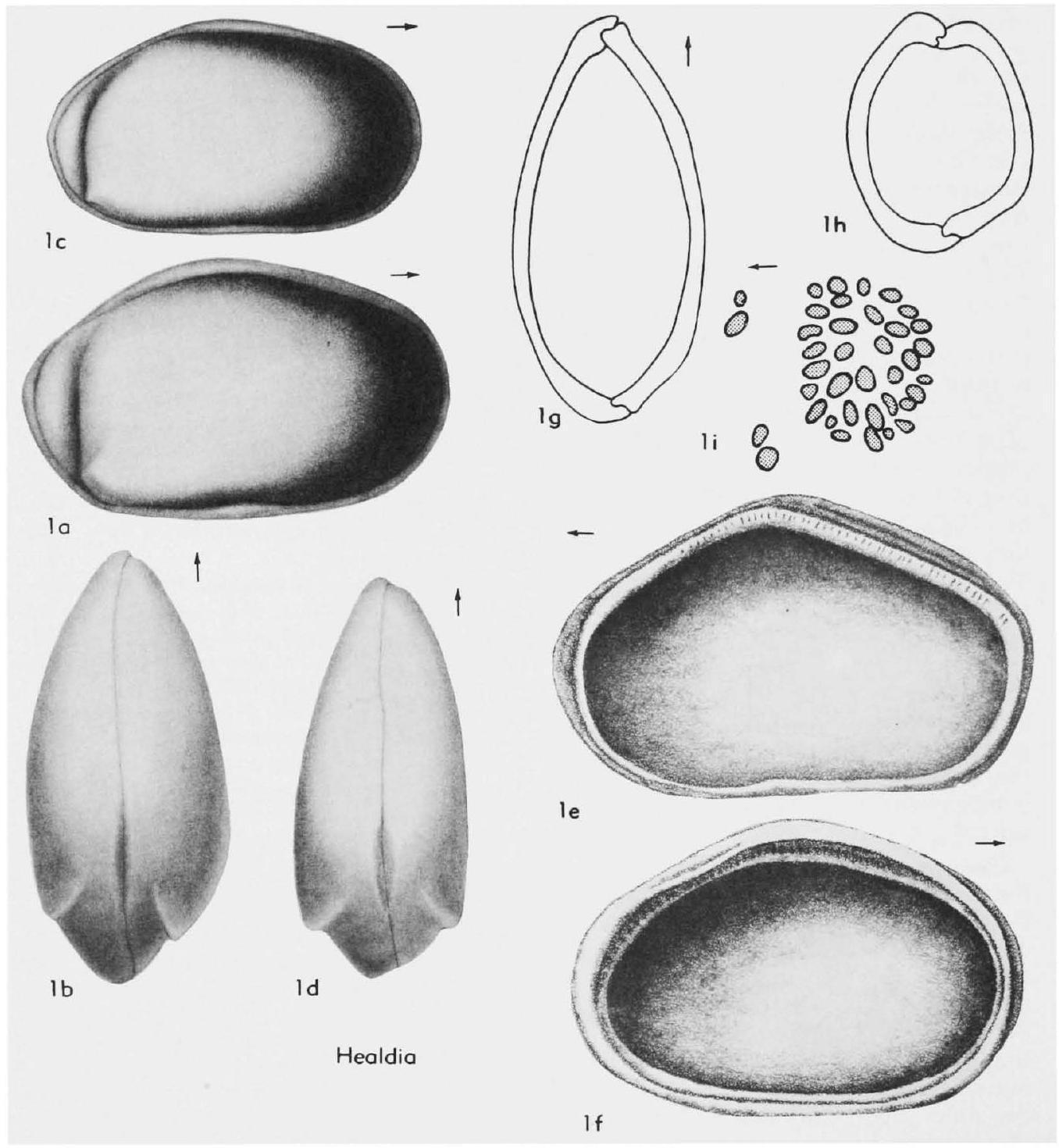 Fig. 279.1a-h. H. cara Bradfield, Penn., USA(Ill.), 1la,b, ?male carapace R, dors., 1c,d, ?female carapace R, dors. ( = H. aspinosa Cooper), X100 (Shaver, n), 1e,, , RV int., LV int., showing marginal areas (Shaver, n), 1g,h, long. and transv. secs., all X100 (Shaver, n). -- Fig. 279,1i. H. sp., Penn., USA(Tex.), muscle scar from RV int., X200 (82).
Synonyms
Geographic Distribution
cosmop.
Age Range
Beginning Stage in Treatise Usage:
Dev.
Beginning International Stage:
Lochkovian
Fraction Up In Beginning Stage:
0
Beginning Date:
419
Ending Stage in Treatise Usage:
Perm.
Ending International Stage:
Changhsingian
Fraction Up In Ending Stage:
100
Ending Date:
251.9
Description
Carapace generally subtriangular in lateral view, with angularly arched dorsum, venter nearly straight, anterior border mostly broadly rounded and posterior end commonly truncate; greatest thickness posterior, producing cuneate appearance in dorsal view; surface of each valve generally smooth and posteriorly sculptured with either a sickle-shaped to straight, vertical ridge or shoulder, or 1 or 2 backward-pointing spines, or both; LV larger than RV, with overlap and overreach of LV over RV but overlap commonly reduced or lacking in hinge area located posterodorsally. Hinge and contact margins consisting of groove or depressed "houlder in LV into which fits edge of RV, which also is grooved or beveled marginally; dorsal elements of articulation of each valve commonly crenulated transversely in numerous, minute toothlets and grooves extending through and beyond hinge area; adductor muscle scar circular, with numerous aggregate spots arranged in concentric rings or rows (121,299, 82).
References
Museum or Author Information
Classification
Phylum:
Arthropoda
Subphylum:
Crustacea (superclass)
Class:
Ostracoda
Order:
Podocopida
Suborder:
Metacopina
Superfamily:
Healdiacea
Family:
Healdiidae
Formal Genus Name and Reference:
Healdia ROUNDY, 1926
Type Species:
H. simplex
Images
(Click to enlarge in a new window)
Fig. 279.1a-h. H. cara Bradfield, Penn., USA(Ill.), 1la,b, ?male carapace R, dors., 1c,d, ?female carapace R, dors. ( = H. aspinosa Cooper), X100 (Shaver, n), 1e,, , RV int., LV int., showing marginal areas (Shaver, n), 1g,h, long. and transv. secs., all X100 (Shaver, n). -- Fig. 279,1i. H. sp., Penn., USA(Tex.), muscle scar from RV int., X200 (82).
Synonyms
Geographic Distribution
cosmop.
Age Range
Beginning Stage in Treatise Usage:
Dev.
Beginning International Stage:
Lochkovian
Fraction Up In Beginning Stage:
0
Beginning Date:
419
Ending Stage in Treatise Usage:
Perm.
Ending International Stage:
Changhsingian
Fraction Up In Ending Stage:
100
Ending Date:
251.9
Description
Carapace generally subtriangular in lateral view, with angularly arched dorsum, venter nearly straight, anterior border mostly broadly rounded and posterior end commonly truncate; greatest thickness posterior, producing cuneate appearance in dorsal view; surface of each valve generally smooth and posteriorly sculptured with either a sickle-shaped to straight, vertical ridge or shoulder, or 1 or 2 backward-pointing spines, or both; LV larger than RV, with overlap and overreach of LV over RV but overlap commonly reduced or lacking in hinge area located posterodorsally. Hinge and contact margins consisting of groove or depressed "houlder in LV into which fits edge of RV, which also is grooved or beveled marginally; dorsal elements of articulation of each valve commonly crenulated transversely in numerous, minute toothlets and grooves extending through and beyond hinge area; adductor muscle scar circular, with numerous aggregate spots arranged in concentric rings or rows (121,299, 82).