
Welcome to the Crustaceans subsite on Invertebrate Paleontology!
Please enter a genera name to retrieve more information.
Cytheropteron
Classification
Phylum:
Arthropoda
Subphylum:
Crustacea (superclass)
Class:
Ostracoda
Order:
Podocopida
Suborder:
Podocopina
Superfamily:
Cytheracea
Family:
Cytheruridae
Formal Genus Name and Reference:
Cytheropteron SARS, 1866
Type Species:
Cythere latissima NORMAN, 1865 (=C. convexum SARS, 1866)
Images
(Click to enlarge in a new window)
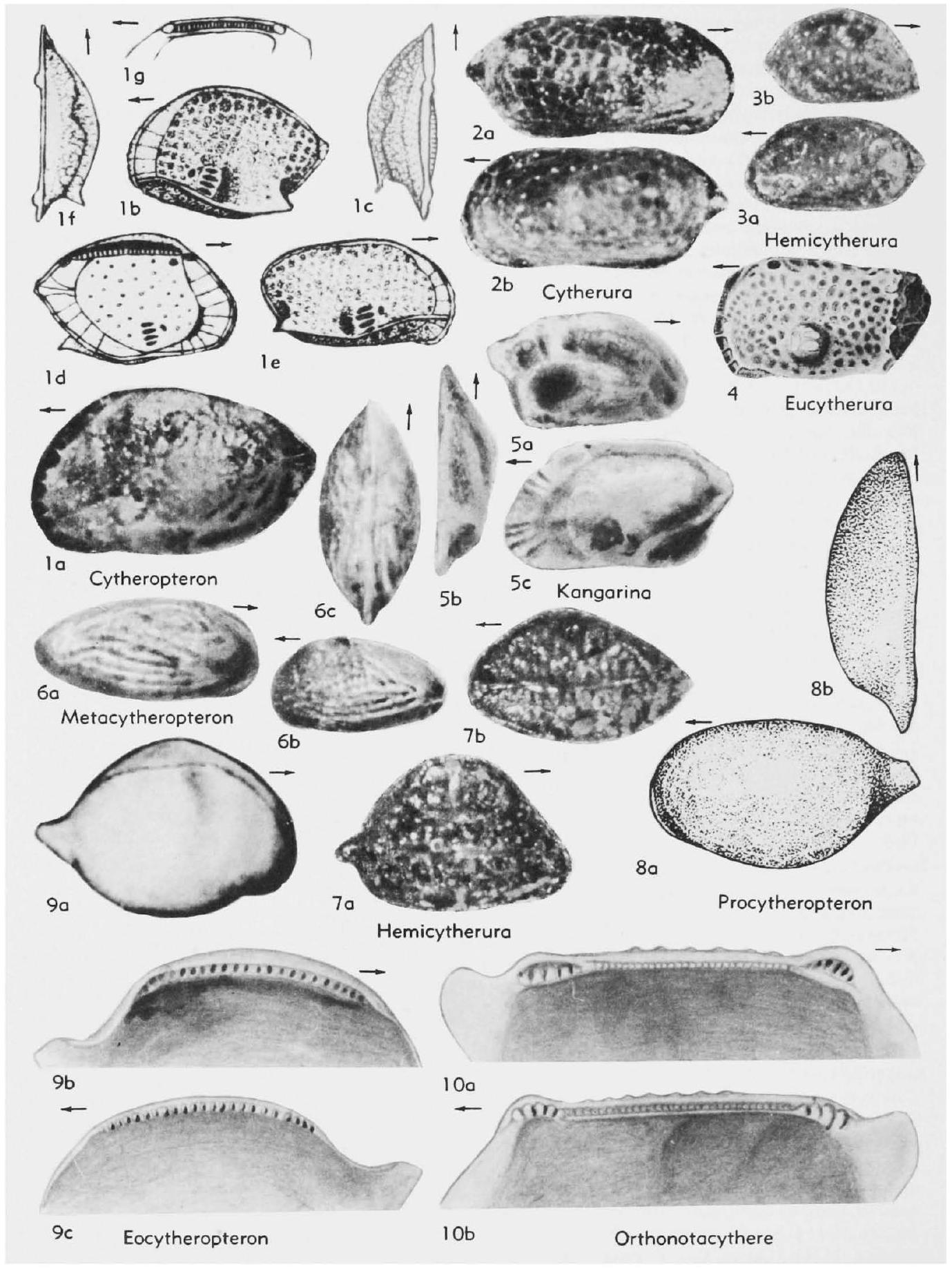 Figs. 219,1a, 220,5. *C. latissimum (NORMAN), Rec., Holl., Kijkduin; 219, 1a, LV lat., X60; 220,5a,b, RV int., dors., X115, X100 (88, by permission of Mouton & Co., The Hague). -- Fig. 219,1b-g, C. aureum (HORNIBROOK), Rec., N.Z. (type species of Aversalvalva); 1b-d, LV lat., dors., int.; 1e-g, RV lat., dors., int.; all X75 (32).
Synonyms
Avusovalva
Geographic Distribution
cosmop.
Age Range
Beginning Stage in Treatise Usage:
U.Jur.
Beginning International Stage:
Oxfordian
Fraction Up In Beginning Stage:
0
Beginning Date:
161.53
Ending Stage in Treatise Usage:
Rec.
Ending International Stage:
Meghalayan
Fraction Up In Ending Stage:
100
Ending Date:
0
Description
Carapace bilamellar, in lateral view roughly ovoid, with oblique caudal process that points obliquely upward (commonly drawn out strongly) and pointed ventrolateral winglike processes, which may be feebly developed; RV slightly larger than LV, overlapping it distinctly along hinge length; surface smooth or ornamented; no eye tubercles. Inner margin and line of concrescence coincident, apart from presence of narrow vestibule at front middle; RV hinge with terminal notched tooth plates united by crenulated furrow; marginal pore canals few, separated widely, undivided, some grouped in 2's and 3's; normal pore canals open; 4 subvertically arranged, elongated adductor muscle scars with V-shaped scar in front of dorsal end of adductor row, and small round scar inside V. Sexual dimorphism present but not pronounced.
References
Museum or Author Information
Classification
Phylum:
Arthropoda
Subphylum:
Crustacea (superclass)
Class:
Ostracoda
Order:
Podocopida
Suborder:
Podocopina
Superfamily:
Cytheracea
Family:
Cytheruridae
Formal Genus Name and Reference:
Cytheropteron SARS, 1866
Type Species:
Cythere latissima NORMAN, 1865 (=C. convexum SARS, 1866)
Images
(Click to enlarge in a new window)
Figs. 219,1a, 220,5. *C. latissimum (NORMAN), Rec., Holl., Kijkduin; 219, 1a, LV lat., X60; 220,5a,b, RV int., dors., X115, X100 (88, by permission of Mouton & Co., The Hague). -- Fig. 219,1b-g, C. aureum (HORNIBROOK), Rec., N.Z. (type species of Aversalvalva); 1b-d, LV lat., dors., int.; 1e-g, RV lat., dors., int.; all X75 (32).
Synonyms
Avusovalva
Geographic Distribution
cosmop.
Age Range
Beginning Stage in Treatise Usage:
U.Jur.
Beginning International Stage:
Oxfordian
Fraction Up In Beginning Stage:
0
Beginning Date:
161.53
Ending Stage in Treatise Usage:
Rec.
Ending International Stage:
Meghalayan
Fraction Up In Ending Stage:
100
Ending Date:
0
Description
Carapace bilamellar, in lateral view roughly ovoid, with oblique caudal process that points obliquely upward (commonly drawn out strongly) and pointed ventrolateral winglike processes, which may be feebly developed; RV slightly larger than LV, overlapping it distinctly along hinge length; surface smooth or ornamented; no eye tubercles. Inner margin and line of concrescence coincident, apart from presence of narrow vestibule at front middle; RV hinge with terminal notched tooth plates united by crenulated furrow; marginal pore canals few, separated widely, undivided, some grouped in 2's and 3's; normal pore canals open; 4 subvertically arranged, elongated adductor muscle scars with V-shaped scar in front of dorsal end of adductor row, and small round scar inside V. Sexual dimorphism present but not pronounced.