
Welcome to the Crustaceans subsite on Invertebrate Paleontology!
Please enter a genera name to retrieve more information.
Cytheridea
Classification
Phylum:
Arthropoda
Subphylum:
Crustacea (superclass)
Class:
Ostracoda
Order:
Podocopida
Suborder:
Podocopina
Superfamily:
Cytheracea
Family:
Cytherideidae
Subfamily:
Cytherideinae
Formal Genus Name and Reference:
Cytheridea BOSQUET, 1852
Type Species:
Cythere mülleri Münster, 1830, SD Brady & NORMAN, 1889
Images
(Click to enlarge in a new window)
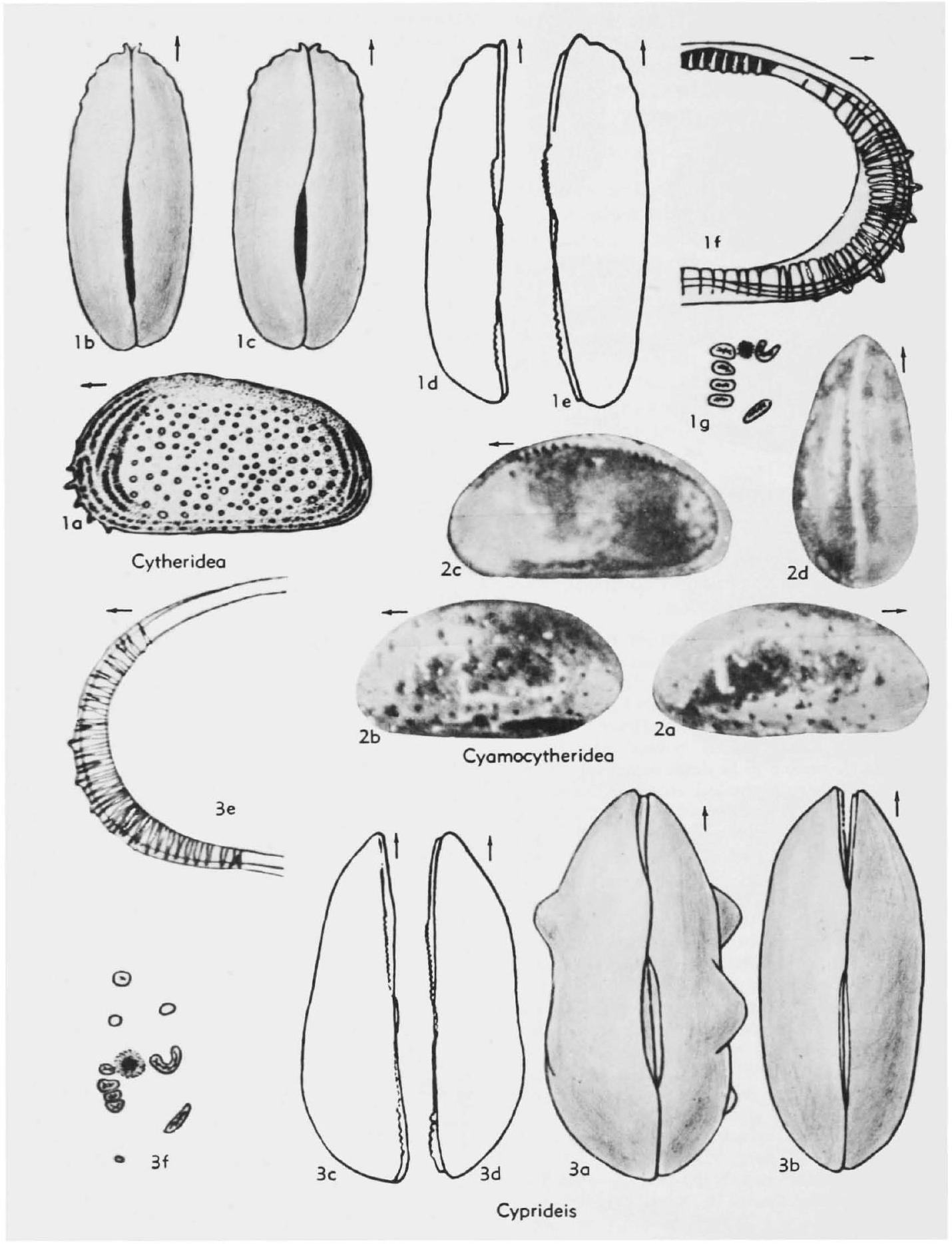
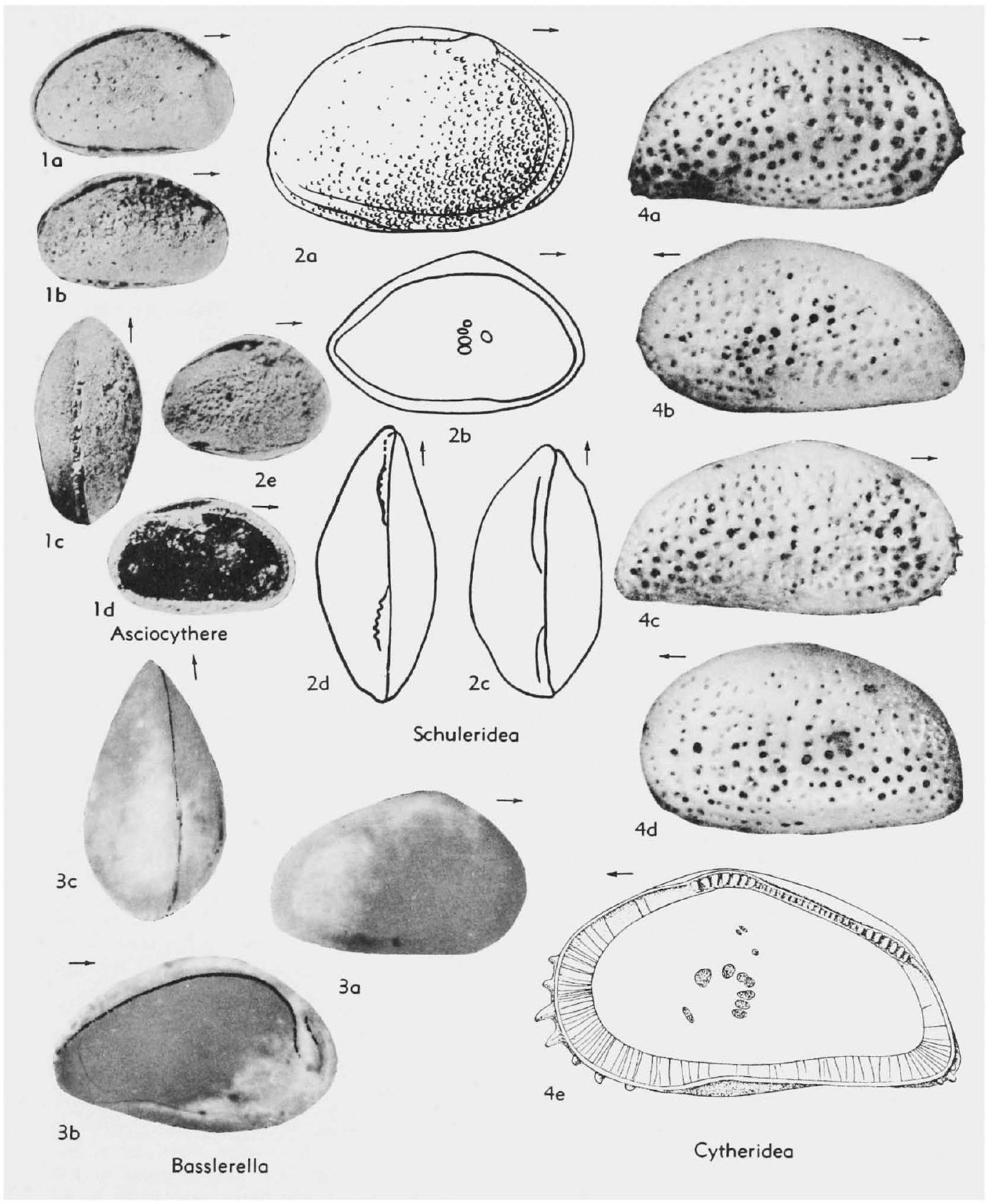 Fig. 201,1. *C. muelleri (Münster), U.Oligo., N.W.Ger., 1a, male carapace (neotype) L, X36, 1b,c, male and female carapaces dors., X36, 1d,e, male LV dors., male RV dors., X56, 1f, male LV int. ant., X56, 1g, muscle scars, X100 (152). -- Fig. 202, 4. C. pernota Oertli & Keij, Oligo.(Tongr.Rupel.), Belg., 4a,b, female RV lat., female LV lat., X60, 4c,d, male RV lat., LV lat., X60, 4e, female RV int., X75 (all 42).
Synonyms
Eucytheridea
Geographic Distribution
Eu.-?N.Am.
Age Range
Beginning Stage in Treatise Usage:
Oligo.
Beginning International Stage:
Rupelian
Fraction Up In Beginning Stage:
0
Beginning Date:
33.9
Ending Stage in Treatise Usage:
Rec.
Ending International Stage:
Meghalayan
Fraction Up In Ending Stage:
100
Ending Date:
0
Description
Carapace thick-shelled, subquadrangular in dorsal view, ovate-triangular in side view, anterior obliquely rounded, posterior oblique, bluntly pointed near venter, both ends tending to be denticulate. Hinge merodont, in LV with terminal crenulate sockets and crenulate meuian element set somewhat obliquely so that anterior portion projects as short bar, back portion being depresseu as furrow; marginal area widest at ends where inner margin and line of concrescence may be separated; radial canals numerous, slightly thickened medially, occurring in groups on anterior; adductor muscle scars in vertical row of 4, with large distinct and smaller less distinct antennal scar in front of upper part usually fused together, anu large mandibular scar in front of lower part with much smaller scar obliquely below and behind it, other scars higher in carapace (260, 341).
References
Museum or Author Information
Classification
Phylum:
Arthropoda
Subphylum:
Crustacea (superclass)
Class:
Ostracoda
Order:
Podocopida
Suborder:
Podocopina
Superfamily:
Cytheracea
Family:
Cytherideidae
Subfamily:
Cytherideinae
Formal Genus Name and Reference:
Cytheridea BOSQUET, 1852
Type Species:
Cythere mülleri Münster, 1830, SD Brady & NORMAN, 1889
Images
(Click to enlarge in a new window)
Fig. 201,1. *C. muelleri (Münster), U.Oligo., N.W.Ger., 1a, male carapace (neotype) L, X36, 1b,c, male and female carapaces dors., X36, 1d,e, male LV dors., male RV dors., X56, 1f, male LV int. ant., X56, 1g, muscle scars, X100 (152). -- Fig. 202, 4. C. pernota Oertli & Keij, Oligo.(Tongr.Rupel.), Belg., 4a,b, female RV lat., female LV lat., X60, 4c,d, male RV lat., LV lat., X60, 4e, female RV int., X75 (all 42).
Synonyms
Eucytheridea
Geographic Distribution
Eu.-?N.Am.
Age Range
Beginning Stage in Treatise Usage:
Oligo.
Beginning International Stage:
Rupelian
Fraction Up In Beginning Stage:
0
Beginning Date:
33.9
Ending Stage in Treatise Usage:
Rec.
Ending International Stage:
Meghalayan
Fraction Up In Ending Stage:
100
Ending Date:
0
Description
Carapace thick-shelled, subquadrangular in dorsal view, ovate-triangular in side view, anterior obliquely rounded, posterior oblique, bluntly pointed near venter, both ends tending to be denticulate. Hinge merodont, in LV with terminal crenulate sockets and crenulate meuian element set somewhat obliquely so that anterior portion projects as short bar, back portion being depresseu as furrow; marginal area widest at ends where inner margin and line of concrescence may be separated; radial canals numerous, slightly thickened medially, occurring in groups on anterior; adductor muscle scars in vertical row of 4, with large distinct and smaller less distinct antennal scar in front of upper part usually fused together, anu large mandibular scar in front of lower part with much smaller scar obliquely below and behind it, other scars higher in carapace (260, 341).