
Welcome to the Crustaceans subsite on Invertebrate Paleontology!
Please enter a genera name to retrieve more information.
Cyprideis
Classification
Phylum:
Arthropoda
Subphylum:
Crustacea (superclass)
Class:
Ostracoda
Order:
Podocopida
Suborder:
Podocopina
Superfamily:
Cytheracea
Family:
Cytherideidae
Subfamily:
Cytherideinae
Formal Genus Name and Reference:
Cyprideis JONES, 1857
Type Species:
*Candona torosa JONES, 1850
Images
(Click to enlarge in a new window)
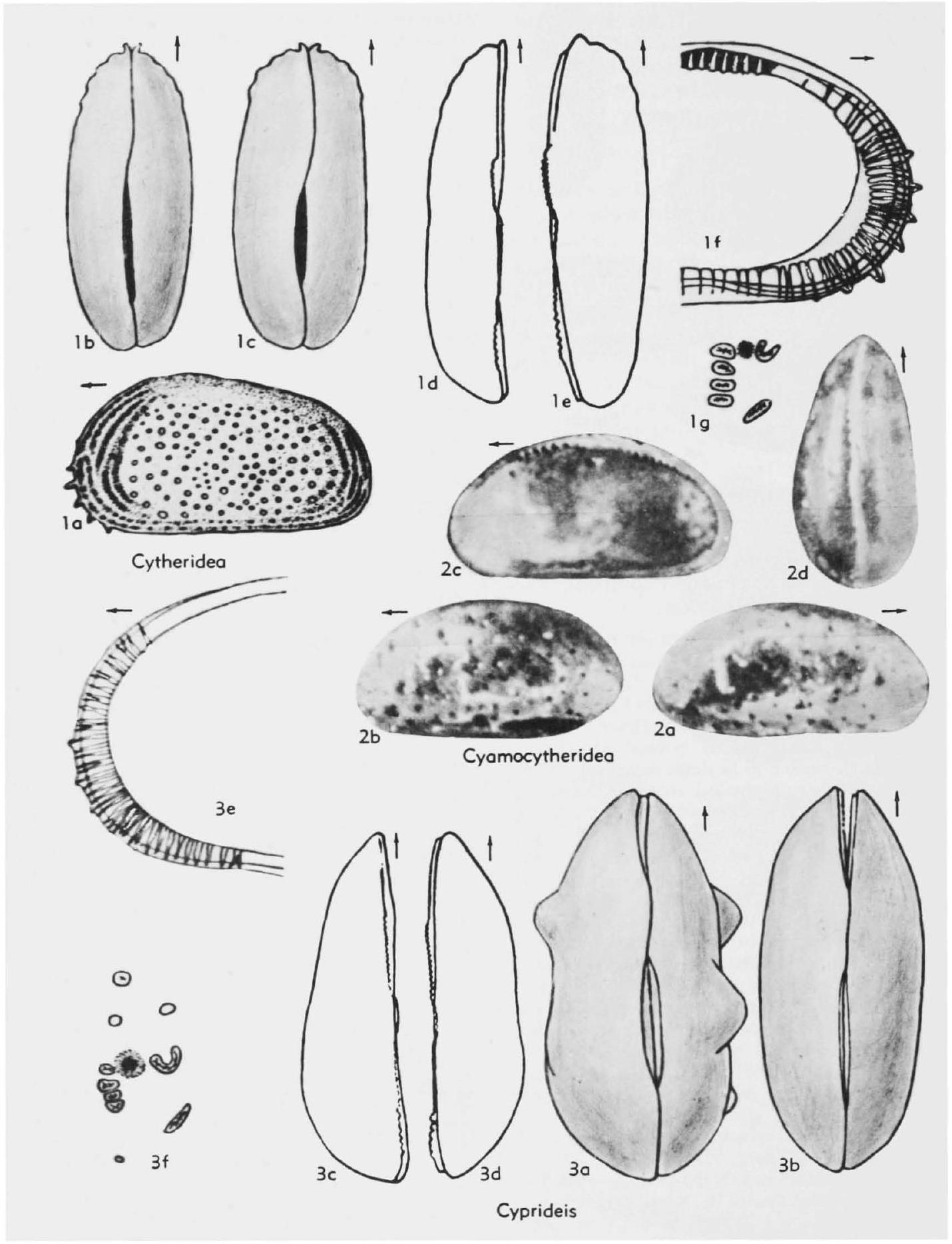 Fig. 201,3, 207,1. *C. torosa (Jones), Pleist. (NW. Ger.) - Rec.(NE.Atl.), 3a,b, female and malecarapaces dors., X58, 3c,d, q LV and RV dors., X55, 3e, female RV int. ant., X90, 3f, muscle scars, X115 (201,3a-g, Pleist., NW.Ger., 152); 207,1a,b, male RV lat., female LV lat., X40; 1c, female LV int., X83; 1d, female carapace long. sec., X47 (207,1a-d, Rec., NE.Atl., 88, by permission of Mouton & Co., The Hague).
Synonyms
Geographic Distribution
Mio.-Rec., Eu.
Age Range
Beginning Stage in Treatise Usage:
Mio.
Beginning International Stage:
Aquitanian
Fraction Up In Beginning Stage:
0
Beginning Date:
23.04
Ending Stage in Treatise Usage:
Rec.
Ending International Stage:
Meghalayan
Fraction Up In Ending Stage:
100
Ending Date:
0
Description
Similar to Cytheridea in shape but more ovate; type species with scattered tubercles on surface. Hinge an entomodont development similar to that in Progonocytherinae, consisting in LV of long crenulate anterior socket with about 15 pits, postjacent short high crenulate ridge merging into shallow furrow, and short posterior crenulate socket with about 6 pits; marginal areas regular, with fairly numerous straight radial canals; muscle scars in vertical row of 4 adductors, above which are 3 small scars, V-shaped antennal scar in front of top of row and mandibular scar in front of bottom of row, with 2nd mandibular scar near ventral margin. Sexual dimorphism pronounced; unlike Cytheridea, ripe ova received in shell cavity for development. [Habitat typically brackish-water.] (38, 68).
References
Jones, T. R., 1857, A monograph of the Tertiary Entomostraca of England: Same, Jones, T. R., 1857, p. 1-68, pl. 1-6.
Museum or Author Information
Classification
Phylum:
Arthropoda
Subphylum:
Crustacea (superclass)
Class:
Ostracoda
Order:
Podocopida
Suborder:
Podocopina
Superfamily:
Cytheracea
Family:
Cytherideidae
Subfamily:
Cytherideinae
Formal Genus Name and Reference:
Cyprideis JONES, 1857
Type Species:
*Candona torosa JONES, 1850
Images
(Click to enlarge in a new window)
Fig. 201,3, 207,1. *C. torosa (Jones), Pleist. (NW. Ger.) - Rec.(NE.Atl.), 3a,b, female and malecarapaces dors., X58, 3c,d, q LV and RV dors., X55, 3e, female RV int. ant., X90, 3f, muscle scars, X115 (201,3a-g, Pleist., NW.Ger., 152); 207,1a,b, male RV lat., female LV lat., X40; 1c, female LV int., X83; 1d, female carapace long. sec., X47 (207,1a-d, Rec., NE.Atl., 88, by permission of Mouton & Co., The Hague).
Synonyms
Geographic Distribution
Mio.-Rec., Eu.
Age Range
Beginning Stage in Treatise Usage:
Mio.
Beginning International Stage:
Aquitanian
Fraction Up In Beginning Stage:
0
Beginning Date:
23.04
Ending Stage in Treatise Usage:
Rec.
Ending International Stage:
Meghalayan
Fraction Up In Ending Stage:
100
Ending Date:
0
Description
Similar to Cytheridea in shape but more ovate; type species with scattered tubercles on surface. Hinge an entomodont development similar to that in Progonocytherinae, consisting in LV of long crenulate anterior socket with about 15 pits, postjacent short high crenulate ridge merging into shallow furrow, and short posterior crenulate socket with about 6 pits; marginal areas regular, with fairly numerous straight radial canals; muscle scars in vertical row of 4 adductors, above which are 3 small scars, V-shaped antennal scar in front of top of row and mandibular scar in front of bottom of row, with 2nd mandibular scar near ventral margin. Sexual dimorphism pronounced; unlike Cytheridea, ripe ova received in shell cavity for development. [Habitat typically brackish-water.] (38, 68).
References
Jones, T. R., 1857, A monograph of the Tertiary Entomostraca of England: Same, Jones, T. R., 1857, p. 1-68, pl. 1-6.