
Welcome to the Crustaceans subsite on Invertebrate Paleontology!
Please enter a genera name to retrieve more information.
Brachycythere
Classification
Phylum:
Arthropoda
Subphylum:
Crustacea (superclass)
Class:
Ostracoda
Order:
Podocopida
Suborder:
Podocopina
Superfamily:
Cytheracea
Family:
Brachycytheridae
Formal Genus Name and Reference:
Brachycythere ALEXANDER, 1933
Type Species:
Cythere sphenoides REUSS, 1854
Images
(Click to enlarge in a new window)
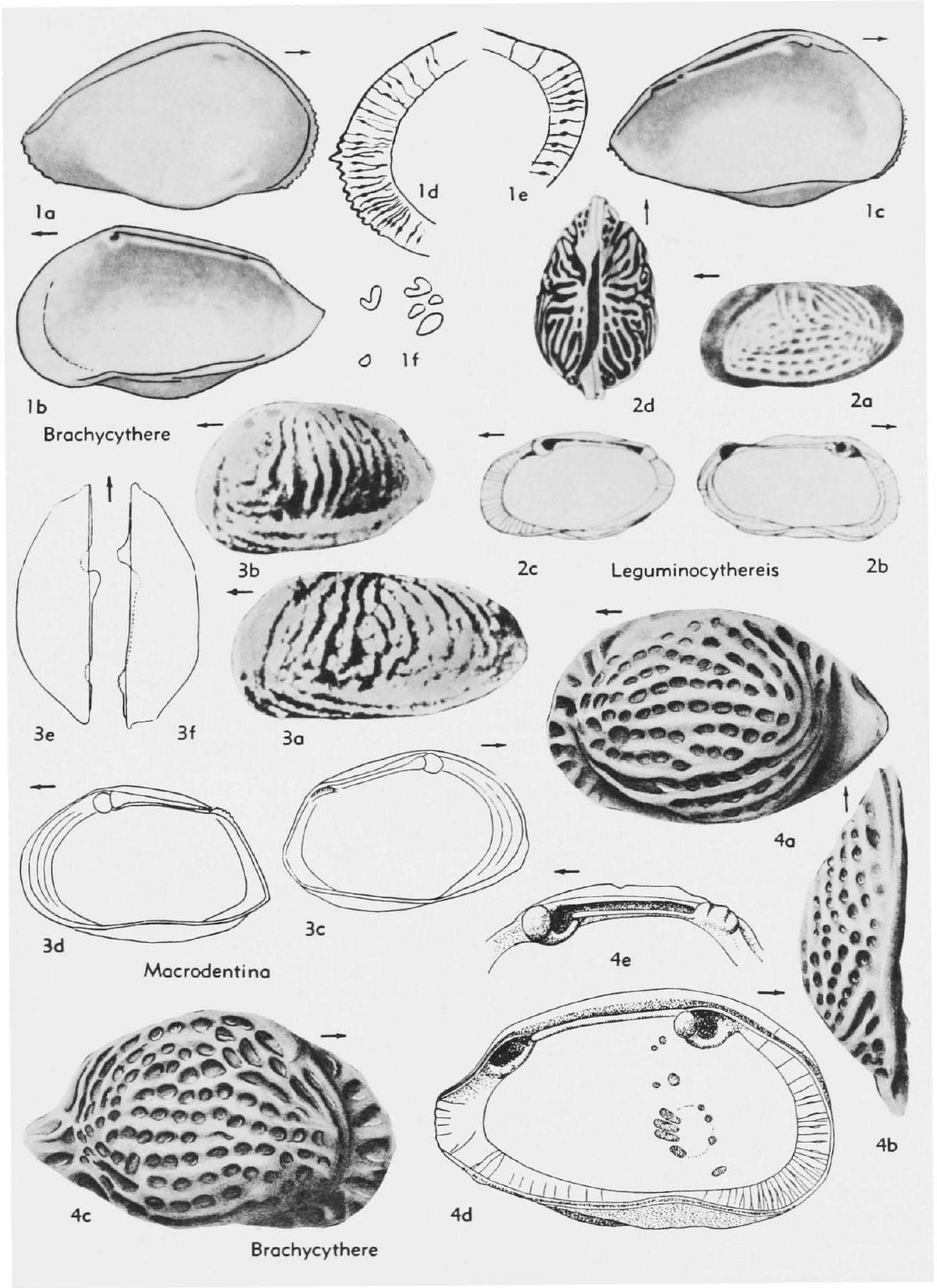
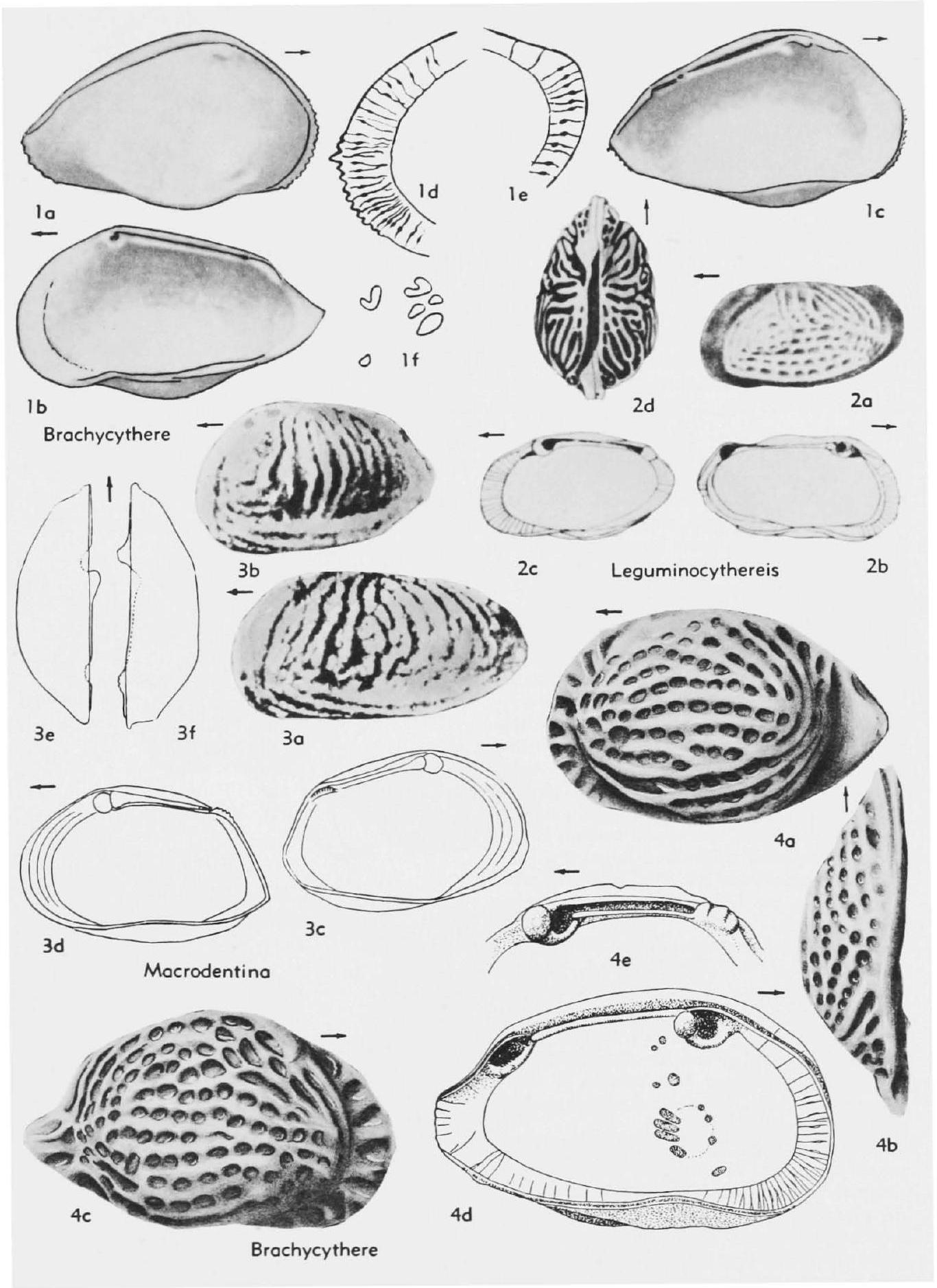
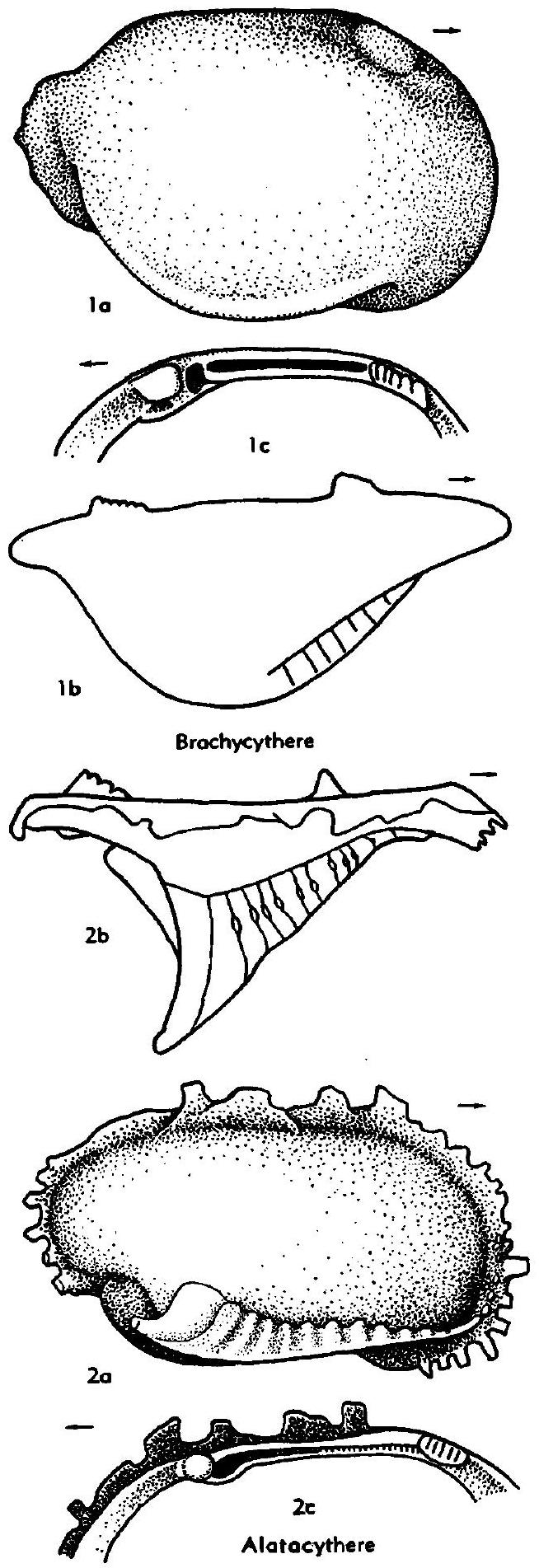 Fig. 188,1. ?*B. sphenoides (Reuss), U.Cret., Texas, 1a,b, carapace R, RV int., X45, 1c, LV int., X45, 1d-f, int. marginal areas, ant., post., and muscle scars, X90 (89). -- Fig. 188,4. B. ventricosa (Bosquet), Eoc., Fr., 4a,b, LV lat., dors. (U.Ypres.), X60, 4c, RV lat. (Lutet.), X60, 4d,e, LV int., RV hinge (U. Ypres.), X75 (42). -- Fig. 189,1. B. plena Alexander, U.Cret., La., 1a-c, RV lat., dors., int., X75 (200).
Synonyms
Geographic Distribution
Eu.-N.Am.
Age Range
Beginning Stage in Treatise Usage:
U.Cret.
Beginning International Stage:
Cenomanian
Fraction Up In Beginning Stage:
0
Beginning Date:
100.5
Ending Stage in Treatise Usage:
Rec.
Ending International Stage:
Meghalayan
Fraction Up In Ending Stage:
100
Ending Date:
0
Description
Carapace subtriangular to subovate in lateral view, plump ventrally, usually with small carina separating flattened ventral face from lateral face; ventral surface usually striated longitudinally, lateral surface smooth to weakly reticulate, eye spot distinct; anterior end broadly anu obliquely rounueu, posterior enu subangulate at or below miuule. Hinge hemiamphiuont; auuuctor scars (in ALEXANDER'S figure of supposed type species) in somewhat vertical row with uppermost scar L-shaped (possibly due to fusion of 2 scars), followeu below by 2 oval scars obliquely side by siue anu below them a large oval scar, V-shapeu antennal scar above oval mandibular scar in front of paireu auductor, (Paleocene species of this genus, however, with upper very oblique pair of auuuctors above 2nd less oblique pair, which in turn overlie 2 nearly fused elongate ovate scars); marginal areas regular, without vestibule; radial canals numerous, tenuing to be bulbous in miu-section; normal canals small, widely spaced. [Characters of this genus cannot be defined adequately until topotype specimens from vicinity of Salzburg, Austria, arc studied.]
References
Museum or Author Information
Classification
Phylum:
Arthropoda
Subphylum:
Crustacea (superclass)
Class:
Ostracoda
Order:
Podocopida
Suborder:
Podocopina
Superfamily:
Cytheracea
Family:
Brachycytheridae
Formal Genus Name and Reference:
Brachycythere ALEXANDER, 1933
Type Species:
Cythere sphenoides REUSS, 1854
Images
(Click to enlarge in a new window)
Fig. 188,1. ?*B. sphenoides (Reuss), U.Cret., Texas, 1a,b, carapace R, RV int., X45, 1c, LV int., X45, 1d-f, int. marginal areas, ant., post., and muscle scars, X90 (89). -- Fig. 188,4. B. ventricosa (Bosquet), Eoc., Fr., 4a,b, LV lat., dors. (U.Ypres.), X60, 4c, RV lat. (Lutet.), X60, 4d,e, LV int., RV hinge (U. Ypres.), X75 (42). -- Fig. 189,1. B. plena Alexander, U.Cret., La., 1a-c, RV lat., dors., int., X75 (200).
Synonyms
Geographic Distribution
Eu.-N.Am.
Age Range
Beginning Stage in Treatise Usage:
U.Cret.
Beginning International Stage:
Cenomanian
Fraction Up In Beginning Stage:
0
Beginning Date:
100.5
Ending Stage in Treatise Usage:
Rec.
Ending International Stage:
Meghalayan
Fraction Up In Ending Stage:
100
Ending Date:
0
Description
Carapace subtriangular to subovate in lateral view, plump ventrally, usually with small carina separating flattened ventral face from lateral face; ventral surface usually striated longitudinally, lateral surface smooth to weakly reticulate, eye spot distinct; anterior end broadly anu obliquely rounueu, posterior enu subangulate at or below miuule. Hinge hemiamphiuont; auuuctor scars (in ALEXANDER'S figure of supposed type species) in somewhat vertical row with uppermost scar L-shaped (possibly due to fusion of 2 scars), followeu below by 2 oval scars obliquely side by siue anu below them a large oval scar, V-shapeu antennal scar above oval mandibular scar in front of paireu auductor, (Paleocene species of this genus, however, with upper very oblique pair of auuuctors above 2nd less oblique pair, which in turn overlie 2 nearly fused elongate ovate scars); marginal areas regular, without vestibule; radial canals numerous, tenuing to be bulbous in miu-section; normal canals small, widely spaced. [Characters of this genus cannot be defined adequately until topotype specimens from vicinity of Salzburg, Austria, arc studied.]