
Welcome to the Crustaceans subsite on Invertebrate Paleontology!
Please enter a genera name to retrieve more information.
Aparchites
Classification
Phylum:
Arthropoda
Subphylum:
Crustacea (superclass)
Class:
Ostracoda
Order:
Palaeocopida
Suborder:
Beyrichicopina
Superfamily:
Oepikellacea
Family:
Aparchitidae?
Formal Genus Name and Reference:
Aparchites JONES, 1889
Type Species:
A. whiteavesi
Images
(Click to enlarge in a new window)
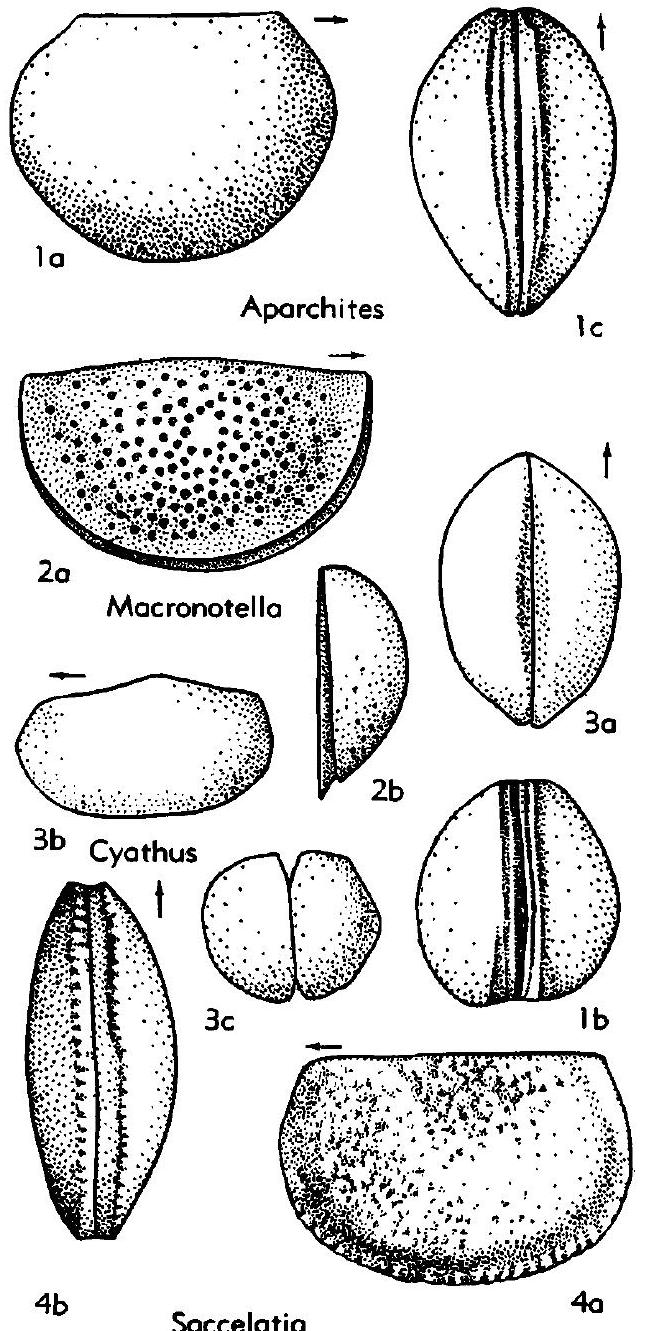 Fig. 107,1. *A. whiteavesi, M.Ord., Can.(Man.), 1a-c, carapace (holotype) R lat, end, vent., X10 (186). -- Fig. 108,2a. ?A. kauDmanensis SWAIN, M.Ord.(Chazy.), USA(Pa.); RV lat., X20 (356). -- Fig. 108,2b-e. ?A. crossotus KESLING, M.Dev., USA(Mich.) ; 2b-e, RV (holotype) lat., lat. showing muscle scar, int., vent., X40 (201). -- Fig. 108,2f-h. A. fimbriatus (ULRICH), M.Ord., USA(Minn.); 2f, ?heteromorph carapace L lat., X22; 2g,h, ?heteromorph carapace L, vent., X22 (J.R. Cornell, n). -- Fig. 109,1. A. fimbriatus (ULRICH), M.Ord. (Edinburg F.), USA (Va.); 1a,b, LV lat., LV int., X10, X9; lc, carapace vent., X13; 1d,e, LV lat., LV lat. (juv. instars), X13; 1f, muscle scar, X22 (J.C. Kraft, n). [In checking proofs, HESSLAND notes that Figures 108 and 109, illustrating species added by the editor, are questionably assignable to Aparchites; moreover, he judges that "A. fimbriatus" actually belongs with oepikellid forms. -Ed.]
Synonyms
Geographic Distribution
Eu.-N. Am.-Austral.-Asia
Age Range
Beginning Stage in Treatise Usage:
L.Ord.
Beginning International Stage:
Tremadocian
Fraction Up In Beginning Stage:
0
Beginning Date:
486.85
Ending Stage in Treatise Usage:
M.Dev.
Ending International Stage:
Givetian
Fraction Up In Ending Stage:
100
Ending Date:
378.9
Description
Carapace generally swollen, hinge line of varying length, distinctly shorter than carapace, cardinal angles as a rule distinctly obtuse, adductor muscle scar not visible exteriorly, velar ridge smooth or tuberculate
References
Museum or Author Information
Classification
Phylum:
Arthropoda
Subphylum:
Crustacea (superclass)
Class:
Ostracoda
Order:
Palaeocopida
Suborder:
Beyrichicopina
Superfamily:
Oepikellacea
Family:
Aparchitidae?
Formal Genus Name and Reference:
Aparchites JONES, 1889
Type Species:
A. whiteavesi
Images
(Click to enlarge in a new window)
Fig. 107,1. *A. whiteavesi, M.Ord., Can.(Man.), 1a-c, carapace (holotype) R lat, end, vent., X10 (186). -- Fig. 108,2a. ?A. kauDmanensis SWAIN, M.Ord.(Chazy.), USA(Pa.); RV lat., X20 (356). -- Fig. 108,2b-e. ?A. crossotus KESLING, M.Dev., USA(Mich.) ; 2b-e, RV (holotype) lat., lat. showing muscle scar, int., vent., X40 (201). -- Fig. 108,2f-h. A. fimbriatus (ULRICH), M.Ord., USA(Minn.); 2f, ?heteromorph carapace L lat., X22; 2g,h, ?heteromorph carapace L, vent., X22 (J.R. Cornell, n). -- Fig. 109,1. A. fimbriatus (ULRICH), M.Ord. (Edinburg F.), USA (Va.); 1a,b, LV lat., LV int., X10, X9; lc, carapace vent., X13; 1d,e, LV lat., LV lat. (juv. instars), X13; 1f, muscle scar, X22 (J.C. Kraft, n). [In checking proofs, HESSLAND notes that Figures 108 and 109, illustrating species added by the editor, are questionably assignable to Aparchites; moreover, he judges that "A. fimbriatus" actually belongs with oepikellid forms. -Ed.]
Synonyms
Geographic Distribution
Eu.-N. Am.-Austral.-Asia
Age Range
Beginning Stage in Treatise Usage:
L.Ord.
Beginning International Stage:
Tremadocian
Fraction Up In Beginning Stage:
0
Beginning Date:
486.85
Ending Stage in Treatise Usage:
M.Dev.
Ending International Stage:
Givetian
Fraction Up In Ending Stage:
100
Ending Date:
378.9
Description
Carapace generally swollen, hinge line of varying length, distinctly shorter than carapace, cardinal angles as a rule distinctly obtuse, adductor muscle scar not visible exteriorly, velar ridge smooth or tuberculate